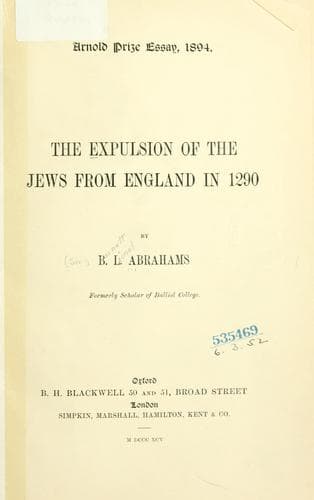
The expulsion of the Jews from England in 1290Abrahams, Barnett Lionel
History
The expulsion of the Jews from England in 1290
Abrahams, Barnett Lionel
Jews -- Great Britain -- History
Though the King was bitterly angry at what had happened, the first
attempt at punishment showed him how powerless he was against the
forces hostile to the Jews. Had the offenders been nobles or prominent
citizens, he could, when the first irresistible disorder had subsided,
have taken vengeance at his leisure. But what could he do against a
collection of serving-men and poor citizens, whom no one knew, who had
come together and had separated in one day? When he departed for the
Crusades, he left behind him all the materials for more outbreaks of
the same kind. In the more populous towns Crusaders were continually
gathering together in order to set out for the Holy Land in company:
and they, aided by the lower citizens, clerics, and poor countrymen,
and in some cases by ruined landholders, fell on and killed the Jews
wherever they had settlements in England, at Norwich, York, Bury St.
Edmunds, Lynn, Lincoln, Colchester, and Stamford.[18] Again the Royal
officers were unable to touch the offenders. When the Chancellor
arrived with an army at York, the scene of the most horrible of all
the massacres, he found that the murderers were Crusaders, who had
long embarked for the Holy Land, peasants and poor townsmen who had
retired from the neighbourhood, and some bankrupt nobles, who had
fled to Scotland. The citizens humbly represented that they were
not responsible for the outrage and were too weak to prevent it. No
punishment was possible except the infliction of a few fines, and the
Chancellor marched back with his army to London.[19]
It was clear that the King must strengthen his connection with the
Jews. He could not afford to lose them or to leave them continually
liable to plunder. They were too rich. In 1187, when Henry II. had
wanted to raise a great sum from all his people he had got nearly as
much from the Jews as from his Christian subjects. From the former he
got a fourth of their property, £60,000, from the latter a tenth, or
£70,000.[20] It is of course improbable that, as these figures would
at first seem to show, the Jews held a quarter of the wealth of the
kingdom, but they were as useful to the King as if they had. He had
a far greater power over their resources than over those of his other
subjects; their wealth was in moveable property, and what was still
more important, it was concentrated in few hands. It was easily found
and easily taken away.[21]
II.--THE CONSTITUTION OF THE JEWRY.
Public-domain text, read in full here on John Shaqi.
Reviews
Reviews
No reviews yet
Be the first to share your thoughts on this work.
Join the Discussion
Join the discussion
Sign in to leave a comment or review.
Sign InorCreate an account