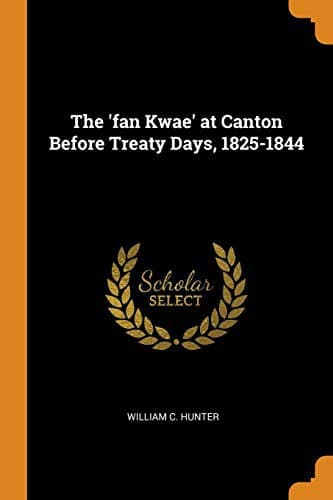
The 'Fan Kwae' at Canton Before Treaty Days 1825-1844Hunter, William C.
History
The 'Fan Kwae' at Canton Before Treaty Days 1825-1844
Hunter, William C.
Guangzhou (China) -- Commerce; Guangzhou (China) -- Description and travel
'We therefore beseech our worthy senior[26] to make known to
the other chin-te-le-mun that they would do well to refrain from
contesting the speed of their boats on the river, so that after
troubles may not accumulate. Then all will be well. Daily may
your prosperity increase, without difference.
'(Signed)
'HOUQUA, MOUQUA, PWANKEIQUA'
AND OTHERS.
The amount of Houqua's fortune was frequently a subject of debate;
but on one occasion, in referring to it in connection with his
various investments in rice-fields, dwellings, shops, and the banking
establishments known as shroffs, and including his American and English
shipments, he estimated it, in 1834, at twenty-six millions of dollars.
Assuming the purchasing power of money at that time as being but twice
greater than at the present day, it would now represent a sum of
$52,000,000. He was a person of remarkably frugal habits (as regards
his style of living) from choice and from being of a feeble frame of
body. His generosity was boundless, and in accounts he was singularly
methodical and precise, never multiplying them beyond what was
absolutely necessary. The two or three rooms which he occupied during
hours of business in his vast, well-regulated Hong were furnished with
simplicity itself.
He withdrew from general business with the foreign community after
the Honourable East India Company left Canton, and confined himself
exclusively to the house of Messrs. Russell & Co. Through them his
foreign business was entirely managed. His yearly shipments to London
of those celebrated Chops of Congo, grown on his family estates in the
Woo-E country, were well known and appreciated in the English market.
His transactions were on a very important scale, and he entrusted them
to his Canton agents, through whom they were carried out, with the
well-merited confidence which they inspired. They embraced England,
the United States, and India. As another illustration of his generous
nature, I may refer to an affair that took place nearly fifty years ago,
in which his orders were not complied with. We had shipped a cargo,
principally of raw silk belonging to himself, which he had ordered
from the silk country. It was sold at a large profit. His instructions
were that the proceeds should be returned in East India Co. bills on
Calcutta. To our surprise and his disappointment, the result of the
sale was invested in a cargo of British goods. It was as injudicious
an arrangement (free trade then beginning) to ship largely of English
manufactures as his own shipment was sagacious, for but little silk was
exported immediately after the opening of the trade. The result showed a
difference of many thousand dollars to his detriment. On the deviation
of orders becoming known Houqua was at once informed that he should not
suffer for this breach of instructions, and for the loss we would credit
his account.
Public-domain text, read in full here on John Shaqi.
Reviews
Reviews
No reviews yet
Be the first to share your thoughts on this work.
Join the Discussion
Join the discussion
Sign in to leave a comment or review.
Sign InorCreate an account