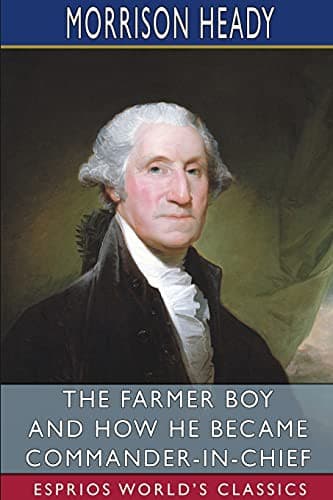
The Farmer Boy, and How He Became Commander-In-ChiefHeady, Morrison
History
The Farmer Boy, and How He Became Commander-In-Chief
Heady, Morrison
Washington, George, 1732-1799
The days on which these measures were to go into effect were observed
by the colonists as days of fasting, prayer, and humiliation. All
business was laid aside, the shops were closed, the churches opened,
and the church-bells tolled as on some funeral occasion; and between
praying at church, and fasting at home, and brooding over their
grievances, the good people were very miserable indeed. Although they
suffered great inconvenience from their observance of the
non-importation agreement, yet they bore it patiently and cheerfully,
like men who felt that their cause was just and right. But the sudden
stoppage of the immense trade that flowed from the colonial ports into
those of the mother-country told dreadfully on the commerce of Great
Britain; and British merchants and British manufacturers, and British
people in general, soon began to suffer even more than the colonists
themselves. Whereupon, a counter stream of petitions and remonstrances
set in upon the king and parliament from the people at home, who
declared that the country would be ruined, if these odious measures,
crippling American commerce, were not speedily withdrawn. Said they,
"If we cannot sell the Americans our broadcloths, our flannels, and
our silks, the obstinate men of that country will stick to their
jeans, and the perverse women to their linsey-woolseys, till we are
undone for ever. In that one pestilent little town of Boston, our
trade in silks alone is not so good by fifty thousand dollars a year
as it has been heretofore: and we humbly entreat that our American
brothers be allowed to trade with us and foreign nations as in days
gone by; for you must see by this time with your own eyes, that we, as
a nation, are growing poorer every day under this state of things,
instead of richer every year as had been expected."
The commissioners--that is to say, the persons who had been appointed
by the British Government to bring or receive the stamp-paper, and
give it circulation throughout the Colonies--were mobbed and pelted by
the indignant people, whenever and wherever they made the least
attempt to do their odious work. In consequence of this determined
opposition, the paper never went into circulation: so it was stocked
away in outhouses, and there left to mould and to be eaten by rats and
mice, if their stomachs were not too dainty for such vile provender.
Thus this famous piece of ingenuity, the Stamp Act, had no other
effect than that of giving the civilized world a hearty laugh, and
increasing the British debt just so much as the paper cost, instead of
lessening it, as its inventors, in their blind confidence, had hoped.
Public-domain text, read in full here on John Shaqi.
Reviews
Reviews
No reviews yet
Be the first to share your thoughts on this work.
Elsewhere in the archive
Join the Discussion
Join the discussion
Sign in to leave a comment or review.
Sign InorCreate an account