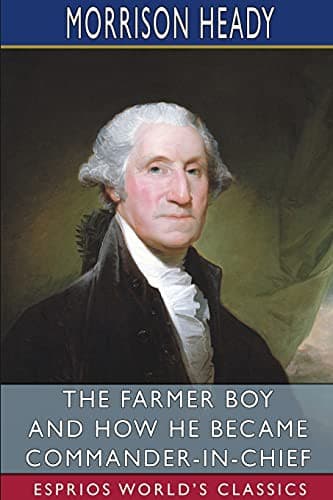
The Farmer Boy, and How He Became Commander-In-ChiefHeady, Morrison
History
The Farmer Boy, and How He Became Commander-In-Chief
Heady, Morrison
Washington, George, 1732-1799
About nine o'clock that night, the firing ceased; and shortly after a
voice was heard, a little distance beyond the palisades, calling upon
the garrison, in the name of Capt. de Villiers, to surrender.
Suspecting this to be but a pretext for getting a spy into the fort,
Col. Washington refused to admit the bearer of the summons. Capt. de
Villiers then requested that an officer be sent to his quarters to
parley; giving his word of honor that no mischief should befall him,
or unfair advantage be taken of it. Whereupon, Capt. Van Braam, the
old Dutch fencing-master, being the only French interpreter
conveniently at hand, was employed to go and bring in the terms of
surrender. He soon came back; but the terms were too dishonorable for
any true soldier to think of accepting. He was sent again, but with no
better result. The third time, Capt. de Villiers sent written articles
of capitulation; which, being in his own language, must needs be first
translated before an answer could be returned. By the flickering light
of one poor candle, which could hardly be kept burning for the pouring
rain, the Dutch captain read the terms he had brought, while the rest
stood round him, gathering what sense they could from the confused
jumbling of bad French, and worse English he was pleased to call a
translation. After this, there followed a little more parleying
between the hostile leaders; when it was at last settled that the
prisoners taken in the Jumonville affair should be set at liberty;
that the English should build no forts upon the disputed territories
within a twelvemonth to come; and that the garrison, after destroying
the artillery and military stores, should be allowed to march out with
all the honors of war, and pursue their way to the settlements,
unmolested either by the French or their Indian allies. When we take
into account the more than double strength of the enemy, the starving
condition of the garrison (still further weakened as it was by the
loss of twelve men killed and forty-three wounded), and the slender
hope of speedy succor from the settlements, these terms must be
regarded as highly honorable to Col. Washington; and still more so
when we add to this the fact, that the Half King and his other Indian
allies had deserted him at the first approach of danger, under the
pretext of finding some safer retreat for their wives and children.
Whether they failed from choice, or hinderance to return, and take
part in the action, can never now be known with certainty.
Public-domain text, read in full here on John Shaqi.
Reviews
Reviews
No reviews yet
Be the first to share your thoughts on this work.
Elsewhere in the archive
Join the Discussion
Join the discussion
Sign in to leave a comment or review.
Sign InorCreate an account