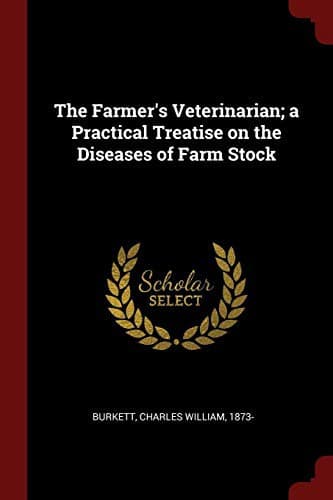
The Farmer's Veterinarian: A Practical Treatise on the Diseases of Farm StockBurkett, Charles William
Science
The Farmer's Veterinarian: A Practical Treatise on the Diseases of Farm Stock
Burkett, Charles William
Veterinary medicine
=STRANGLES.=--This trouble, commonly called colt distemper, affects
horses, and rarely mules and donkeys. It is such an infectious disease
that nearly all horses contract the disease when colts and usually
remain immune to future exposures. The cause is a very small organism or
germ which enters the system when a healthy colt comes in contact with
a diseased one or when fed and watered in infected vessels. The seat of
trouble is largely restricted to the respiratory organs, occasionally
causing difficulty in breathing, owing to swelling in region of throat
or to accumulations in air passages.
The symptoms start out with more or less sluggishness. The animal eats
little, and does not care to take much exercise. A little watery
discharge frequently appears from the eyes, and about the same time a
watery discharge from the nostrils, which soon becomes thicker and more
yellow in color. Usually the glands between the lower jawbones become
enlarged and undergo suppuration with a rupture of them and free
discharge of pus. The temperature of the animal may be slightly or very
greatly increased from 103° to 105°. The pulsations may also be
considerably quickened. When complications do not occur this disease
usually runs its course in two weeks, leaving the animal little the
worse for having passed through the affliction.
The milder forms of this disease will need little or no treatment other
than careful feeding and nursing. A laxative diet, with something green,
if possible, should be given. The colt should be placed in clean, airy,
and comfortable quarters, but not in a draft. To hasten the suppuration
of the glands a poultice of hot bran or flaxseed may be applied to that
region, and as soon as softening can be detected within, puncture the
gland containing abscess with a clean knife blade and allow the escape
of the collection of pus. During the course of the disease the animal
should not be worked and care should be taken that it be not exposed to
conditions likely to produce a cold.
Public-domain text, read in full here on John Shaqi.
Reviews
Reviews
No reviews yet
Be the first to share your thoughts on this work.
Elsewhere in the archive
Join the Discussion
Join the discussion
Sign in to leave a comment or review.
Sign InorCreate an account