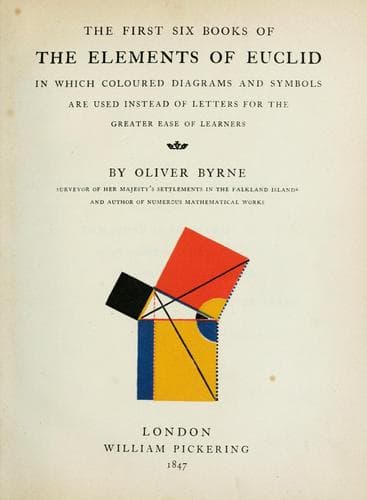
The First Six Books of the Elements of EuclidEuclid
Science
The First Six Books of the Elements of Euclid
Euclid
Euclid's Elements; Mathematics, Greek
Now, it is evident that if is greater than unity, is greater than unity; but if
is greater than unity, ma is greater than nb; and if is greater than unity, mc is
greater than nd. In like manner, if ma be equal to nb, mc is equal to nd; and if less,
less.
The foregoing is an easy proof of the converse of the theorem which is contained in Euclid’s
celebrated Fifth Definition.
Next, to prove Euclid’s theorem—that if, according as the multiple of the first of four
magnitudes is greater than, equal to, or less than the multiple of the second, the multiple of the
third is greater than, equal to, or less than the multiple of the fourth; the ratio of the first to the
second is equal to the ratio of the third to the fourth.
Dem.—Let, a, b, c, d be the four magnitudes. First suppose that a and b are commensurable,
then it is evident that we can take multiples na, mb, such that na = mb. Hence, by hypothesis,
nc = md. Thus,
therefore = .
Next, suppose a and b are incommensurable. Then, as in a recent note, we can find two numbers m
and n, such that is greater than unity, but less than unity. Hence lies between
and . Now, since by hypothesis, when is greater than unity, is greater than unity; and
when is less than unity, is less than unity. Hence, since lies between
and , lies between the same quantities. Therefore the difference between and
is less than ; and since n may be as large as we please, the difference is nothing;
therefore
vii. When of the multiples of four magnitudes (taken as in Def. v.) the multiple
of the first is greater than that of the second, but the multiple of the third not
greater than that of the fourth, the first has to the second a greater ratio than the
third has to the fourth.
This, instead of being a definition, is a theorem. We have altered the last clause from that given
in Simson’s Euclid, which runs thus:—“The first is said to have to the second a greater ratio than
the third has to the fourth.” This is misleading, as it implies that it is, by convention, that the first
ratio is greater than the second, whereas, in fact, such is not the case; for it follows from the
hypothesis that the first ratio is greater than the second; and if it did not, it could not be
made so by definition. We have made a similar change in the enunciation of the Fifth
Definition.
Let a, b, c, d be the four magnitudes, and m and n the multiples taken, it is required to prove,
that if ma be greater than nb, but mc not greater than nd, that the ratio a : b is greater than the
ratio c : d.
Dem.—Since ma is greater than nb, but mc not greater than nd, it is evident that
is greater than ;
therefore is greater than ;
that is, the ratio a : b is greater than the ratio c : d.
ix. Proportion consists of three terms at least.
Public-domain text, read in full here on John Shaqi.
Reviews
Reviews
No reviews yet
Be the first to share your thoughts on this work.
Elsewhere in the archive
Join the Discussion
Join the discussion
Sign in to leave a comment or review.
Sign InorCreate an account