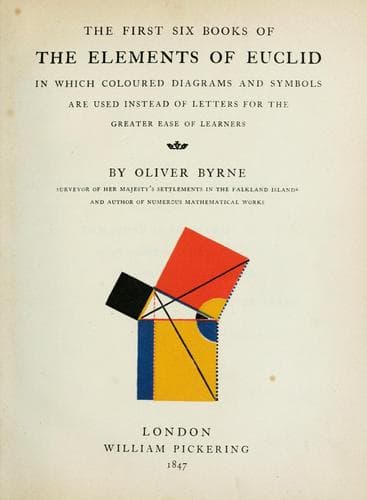
The First Six Books of the Elements of EuclidEuclid
Science
The First Six Books of the Elements of Euclid
Euclid
Euclid's Elements; Mathematics, Greek
8. If three magnitudes be continual proportionals, the first is to the third as the square of the
difference between the first and second is to the square of the difference between the second and
third.
9. If a line AB, cut harmonically in C and D, be bisected in O; prove OC, OB, OD are
continual proportionals.
10. In the same case, if O′ be the middle point of CD; prove OO′2 = OB2 + O′D2.
11. And AB(AC + AD) = 2AC.AD, or + = .
12. And CD(AD + BD) = 2AD.BD, or + = .
13. And AB.CD = 2AD.CB.
BOOK VI.
APPLICATION OF THE THEORY OF PROPORTION
________________
DEFINITIONS.
i. Similar Rectilineal Figures are those whose several angles are equal, each to
each, and whose sides about the equal angles are proportional.
Similar figures agree in shape; if they agree also in size, they are congruent.
1. When the shape of a figure is given, it is said to be given in species. Thus a triangle whose
angles are given is given in species. Hence similar figures are of the same species.
2. When the size of a figure is given, it is said to be given in magnitude; for instance, a square
whose side is of given length.
3. When the place which a figure occupies is known, it is said to be given in position.
ii. A right line is said to be cut at a point in extreme and mean ratio when
the whole line is to the greater segment as the greater segment is to the
less.
iii. If three quantities of the same kind be in continued proportion, the middle
term is called a mean proportional between the other two.
Magnitudes in continued proportion are also said to be in geometrical
progression.
iv. If four quantities of the same kind be in continued proportion, the two middle
terms are called two mean proportionals between the other two.
v. The altitude of any figure is the length of the perpendicular from its highest
point to its base.
vi. Two corresponding angles of two figures have the sides about them
reciprocally proportional, when a side of the first is to a side of the second as the
remaining side of the second is to the remaining side of the first.
This is evidently equivalent to saying that a side of the first is to a side of the second in the
reciprocal ratio of the remaining side of the first to the remaining side of the second.
PROP. I.—Theorem.
Triangles (ABC, ACD) and parallelograms (EC, CF) which have the same
altitude are to one another as their bases (BC, CD).
Dem.—Produce BD both ways, and cut off any number of parts BG, GH, &c.,
each equal to CB, and any number DK, KL, each equal to CD. Join AG, AH, AK,
AL.
Public-domain text, read in full here on John Shaqi.
Reviews
Reviews
No reviews yet
Be the first to share your thoughts on this work.
Elsewhere in the archive
Join the Discussion
Join the discussion
Sign in to leave a comment or review.
Sign InorCreate an account