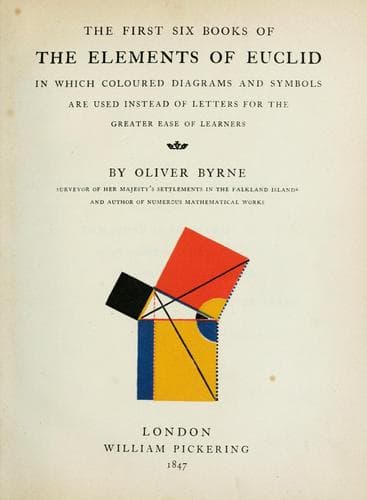
The First Six Books of the Elements of EuclidEuclid
Science
The First Six Books of the Elements of Euclid
Euclid
Euclid's Elements; Mathematics, Greek
Now, since the several bases CB, BG, GH are all equal, the triangles ACB,
ABG, AGH are also all equal [I. xxxviii.]. Therefore the triangle ACH is the same
multiple of ACB that the base CH is of the base CB. In like manner, the
triangle ACL is the same multiple of ACD that the base CL is of the base
CD; and it is evident that [I. xxxviii.] if the base HC be greater than CL,
the triangle HAC is greater than CAL; if equal, equal; and if less, less.
Now we have four magnitudes: the base BC is the first, the base CD the
second, the triangle ABC the third, and the triangle ACD the fourth. We
have taken equimultiples of the first and third, namely, the base CH, and
the triangle ACH; also equimultiples of the second and fourth, namely, the
base CL, and the triangle ACL; and we have proved that according as the
multiple of the first is greater than, equal to, or less than the multiple of the
second, the multiple of the third is greater than, equal to, or less than the
multiple of the fourth. Hence [V. Def. v.] the base BC : CD :: the triangle
ABC : ACD.
2. The parallelogram EC is double of the triangle ABC [I. xxxiv.], and the
parallelogram CF is double of the triangle ACD. Hence [V. xv.] EC : CF :: the
triangle ABC : ACD; but ABC : ACD :: BC : CD (Part I.). Therefore [V. xi.]
EC : CF :: the base BC : CD.
Or thus: Let A, A′ denote the areas of the triangles ABC, ACD, respectively, and P their
common altitude; then [II. i., Cor. 1],
A = P.BC, A′ = P.CD.
Hence = , or A : A′ :: BC : CD.
In extending this proof to parallelograms we have only to use P instead of P.
PROP. II.—Theorem.
If a line (DE) be parallel to a side (BC) of a triangle (ABC), it divides
the remaining sides, measured from the opposite angle (A), proportionally;
and, conversely, If two sides of a triangle, measured from an angle, be cut
proportionally, the line joining the points of section is parallel to the third
side.
1. It is required to prove that AD : DB :: AE : EC.
Dem.—Join BE, CD. The triangles BDE, CED are on the same base DE, and
between the same parallels BC, DE. Hence [I. xxxvii.] they are equal, and therefore
[V. vii.] the triangle ADE : BDE :: ADE : CDE;
but ADE : BDE :: AD : DB [i.],
and ADE : CDE :: AE : EC [i.].
Hence AD : DB :: AE : EC.
2. If AD : DB :: AE : EC, it is required to prove that DE is parallel to
BC.
Dem.—Let the same construction be made;
then AD : DB :: the triangle ADE : BDE [i.].
and AE : EC :: the triangle ADE : CDE [i.];
but AD : DB :: AE : EC (hyp.).
Hence ADE : BDE :: ADE : CDE.
Therefore [V. ix.] the triangle BDE is equal to CDE, and they are on the same base
DE, and on the same side of it; hence they are between the same parallels
[I. xxxix.]. Therefore DE is parallel to BC.
Observation.—The line DE may cut the sides AB, AC produced through B, C, or through the
angle A; but evidently a separate figure for each of these cases is unnecessary.
Exercise.
Public-domain text, read in full here on John Shaqi.
Reviews
Reviews
No reviews yet
Be the first to share your thoughts on this work.
Elsewhere in the archive
Join the Discussion
Join the discussion
Sign in to leave a comment or review.
Sign InorCreate an account