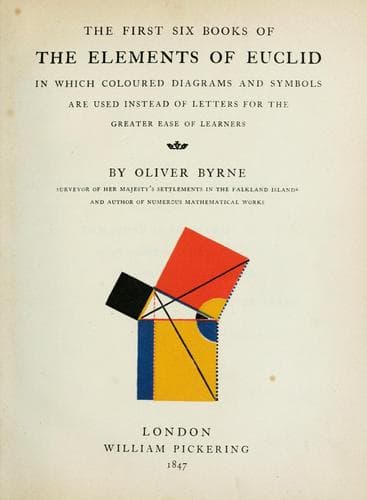
The First Six Books of the Elements of EuclidEuclid
Science
The First Six Books of the Elements of Euclid
Euclid
Euclid's Elements; Mathematics, Greek
If two lines be cut by three or more parallels, the intercepts on one are proportional to the
corresponding intercepts on the other.
PROP. III.—Theorem.
If a line (AD) bisect any angle (A) of a triangle (ABC), it divides the opposite side
(BC) into segments proportional to the adjacent sides. Conversely, If the segments
(BD, DC) into which a line (AD) drawn from any angle (A) of a triangle divides
the opposite side be proportional to the adjacent sides, that line bisects the angle
(A).
Dem.—1. Through C draw CE parallel to AD, to meet BA produced in E.
Because BA meets the parallels AD, EC, the angle BAD [I. xxix.] is equal to AEC;
and because AC meets the parallels AD, EC, the angle DAC is equal to ACE; but
the angle BAD is equal to DAC (hyp.); therefore the angle ACE is equal to AEC;
therefore AE is equal to AC [I. vi.]. Again, because AD is parallel to EC, one of the
sides of the triangle BEC, BD : DC :: BA : AE [ii.]; but AE has been proved equal
to AC. Therefore BD : DC :: BA : AC.
2. If BD : DC :: BA : AC, the angle BAC is bisected.
Dem.—Let the same construction be made.
Because AD is parallel to EC, BA : AE :: BD : DC [ii.]; but BD : DC :: BA : AC
(hyp.). Therefore [V. xi.] BA : AE :: BA : AC, and hence [V. ix.] AE is equal to
AC; therefore the angle AEC is equal to ACE; but AEC is equal to BAD [I. xxix.],
and ACE to DAC; hence BAD is equal to DAC, and the line AD bisects the angle
BAC.
Exercises.
1. If the line AD bisect the external vertical angle CAE, BA : AC :: BD : DC, and
conversely.
Dem.—Cut off AE = AC. Join ED. Then the triangles ACD, AED are evidently
congruent; therefore the angle EDB is bisected; hence [iii.] BA : AE :: BD : DE; or
BA : AC :: BD : DC.
2. Exercise 1 has been proved by quoting Proposition iii. Prove it independently, and prove
iii. as an inference from it.
3. The internal and the external bisectors of the vertical angle of a triangle divide the base
harmonically (see Definition, p. 191).
4. Any line intersecting the legs of any angle is cut harmonically by the internal and external
bisectors of the angle.
5. Any line intersecting the legs of a right angle is cut harmonically by any two lines through its
vertex which make equal angles with either of its sides.
6. If the base of a triangle be given in magnitude and position, and the ratio of the sides, the
locus of the vertex is a circle which divides the base harmonically in the ratio of the
sides.
7. If a, b, c denote the sides of a triangle ABC, and D, D′ the points where the internal and
external bisectors of A meet BC; prove
8. In the same case, if E, E′, F, F′ be points similarly determined on the sides CA, AB,
respectively; prove
+ + = 0,
and + + = 0.
PROP. IV.—Theorem.
Public-domain text, read in full here on John Shaqi.
Reviews
Reviews
No reviews yet
Be the first to share your thoughts on this work.
Elsewhere in the archive
Join the Discussion
Join the discussion
Sign in to leave a comment or review.
Sign InorCreate an account