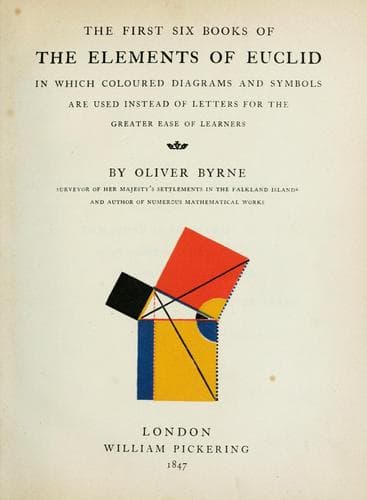
The First Six Books of the Elements of EuclidEuclid
Science
The First Six Books of the Elements of Euclid
Euclid
Euclid's Elements; Mathematics, Greek
The sides about the equal angles of equiangular triangles (BAC, CDE) are
proportional, and those which are opposite to the equal angles are homologous.
Dem.—Let the sides BC, CE, which are opposite to the equal angles A and D,
be conceived to be placed so as to form one continuous line, the triangles being on
the same side, and so that the equal angles BCA, CED may not have a common
vertex.
Now, the sum of the angles ABC, BCA is less than two right angles; but BCA is
equal to BED (hyp.). Therefore the sum of the angles ABE, BED is less than two
right angles; hence [I., Axiom xii.] the lines AB, ED will meet if produced. Let them
meet in F. Again, because the angle BCA is equal to BEF, the line CA [I. xxviii.]
is parallel to EF. In like manner, BF is parallel to CD; therefore the figure ACDF
is a parallelogram; hence AC is equal to DF, and CD is equal to AF. Now, because
AC is parallel to FE, BA : AF :: BC : CE [ii.]; but AF is equal to CD, therefore
BA : CD :: BC : CE; hence [V. xvi.]; AB : BC :: DC : CE. Again, because CD is
parallel to BF, BC : CE :: FD : DE; but FD is equal to AC, therefore
BC : CE :: AC : DE; hence [V. xvi.] BC : AC :: CE : DE. Therefore we have
proved that AB : BC :: DC : CE, and that BC : CA :: CE : ED. Hence (ex
aequali) AB : AC :: DC : DE. Therefore the sides about the equal angles are
proportional.
This Proposition may also be proved very simply by superposition. Thus (see fig., Prop. ii.): let
the two triangles be ABC, ADE; let the second triangle ADE be conceived to be placed on ABC,
so that its two sides AD, AE may fall on the sides AB, AC; then, since the angle ADE is equal to
ABC, the side DE is parallel to BC. Hence [ii.] AD : DB :: AE : EC; hence AD : AB :: AE : AC,
and [V. xvi.] AD : AE :: AB : AC. Therefore the sides about the equal angles BAC, DAE are
proportional, and similarly for the others.
It can be proved by this Proposition that two lines which meet at infinity are parallel. For, let I
denote the point at infinity through which the two given lines pass, and draw any two parallels
intersecting them in the points A, B; A′, B′; then the triangles AIB, A′IB′ are equiangular;
therefore AI : AB :: A′I : A′B′; but the first term of the proportion is equal to the third; therefore
[V. xiv.] the second term AB is equal to the fourth A′B′, and, being parallel to it, the lines AA′,
BB′ [I. xxxiii.] are parallel.
Exercises.
1. If two circles intercept equal chords AB, A′B′ on any secant, the tangents AT,
A′T to the circles at the points of intersection are to one another as the radii of the
circles.
2. If two circles intercept on any secant chords that have a given ratio, the tangents to the
circles at the points of intersection have a given ratio, namely, the ratio compounded of the direct
ratio of the radii and the inverse ratio of the chords.
Public-domain text, read in full here on John Shaqi.
Reviews
Reviews
No reviews yet
Be the first to share your thoughts on this work.
Elsewhere in the archive
Join the Discussion
Join the discussion
Sign in to leave a comment or review.
Sign InorCreate an account