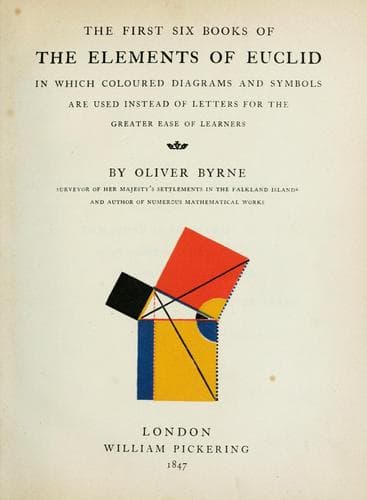
The First Six Books of the Elements of EuclidEuclid
Science
The First Six Books of the Elements of Euclid
Euclid
Euclid's Elements; Mathematics, Greek
3. Being given a circle and a line, prove that a point may be found, such that the rectangle of
the perpendiculars let fall on the line from the points of intersection of the circle with any chord
through the point shall be given.
4. AB is the diameter of a semicircle ADB; CD a perpendicular to AB; draw through
A a chord AF of the semicircle meeting CD in E, so that the ratio CE : EF may be
given.
PROP. V.–Theorem.
If two triangles (ABC, DEF) have their sides proportional
(BA : AC :: ED : DF; AC : CB :: DF : FE) they are equiangular, and those angles
are equal which are subtended by the homologous sides.
Dem.—At the points D, E make the angles EDG, DEG equal to the angles
A, B of the triangle ABC. Then [I. xxxii.] the triangles ABC, DEG are
equiangular.
Therefore BA : AC :: ED : DG [iv.];
but BA : AC :: ED : DF (hyp.).
Therefore DG is equal to DF. In like manner it may be proved that EG is equal to
EF. Hence the triangles EDF, EDG have the sides ED, DF in one equal to the
sides ED, DG in the other, and the base EF equal to the base EG. Hence [I. viii.]
they are equiangular; but the triangle DEG is equiangular to ABC. Therefore the
triangle DEF is equiangular to ABC.
Observation.—In VI. Def. i. two conditions are laid down as necessary for the similitude of
rectilineal figures. 1. The equality of angles; 2. The proportionality of sides. Now, from Propositions
iv. and v., we see that if two triangles possess either condition, they also possess the other.
Triangles are unique in this respect. In all other rectilineal figures one of the conditions may exist
without the other. Thus, two quadrilaterals may have their sides proportional without having equal
angles, or vice versâ.
PROP. VI.—Theorem.
If two triangles (ABC, DEF) have one angle (A) in one equal to one angle (D) in
the other, and the sides about these angles proportional (BA : AC :: ED : DF), the
triangles are equiangular, and have those angles equal which are opposite to the
homologous sides.
Dem.—Make the same construction as in the last Proposition; then the triangles
ABC, DEG are equiangular.
Therefore BA : AC :: ED : DG [iv.];
but BA : AC :: ED : DF (hyp.).
Therefore DG is equal to DF. Again, because the angle EDG is equal to BAC
(const.), and BAC equal to EDF (hyp.), the angle EDG is equal to EDF; and it
has been proved that DG is equal to DF, and DE is common; hence the triangles
EDG and EDF are equiangular; but EDG is equiangular to BAC. Therefore EDF
is equiangular to BAC.
[It is easy to see, as in the case of Proposition iv., that an immediate proof of this Proposition
can also be got from Proposition ii.].
Cor. 1.—If the ratio of two sides of a triangle be given, and the angle between
them, the triangle is given in species.
PROP. VII.—Theorem.
Public-domain text, read in full here on John Shaqi.
Reviews
Reviews
No reviews yet
Be the first to share your thoughts on this work.
Elsewhere in the archive
Join the Discussion
Join the discussion
Sign in to leave a comment or review.
Sign InorCreate an account