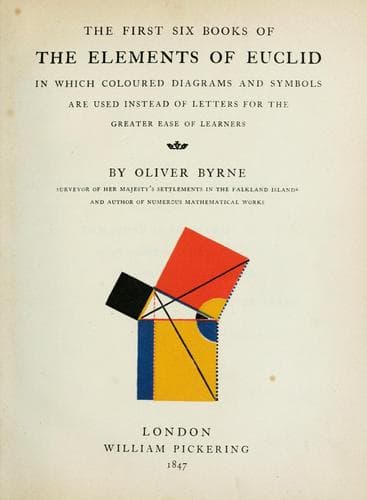
The First Six Books of the Elements of EuclidEuclid
Science
The First Six Books of the Elements of Euclid
Euclid
Euclid's Elements; Mathematics, Greek
9. The rectangle contained by the side of an inscribed square standing on the base
of a triangle, and the sum of the base and altitude, is equal to twice the area of the
triangle.
10. The rectangle contained by the side of an escribed square standing on the base of a
triangle, and the difference between the base and altitude, is equal to twice the area of the
triangle.
11. If from any point P in the circumference of a circle a perpendicular be drawn to any chord,
its square is equal to the rectangle contained by the perpendiculars from the extremities of the chord
on the tangent at P.
12. If O be the point of intersection of the diagonals of a cyclic quadrilateral ABCD, the four
rectangles AB.BC, BD.CD, CD.DA, DA.AB, are proportional to the four lines BO, CO, DO,
AO.
13. The sum of the rectangles of the opposite sides of a cyclic quadrilateral ABCD is equal to
the rectangle contained by its diagonals.
Dem.—Make the angle DAO = CAB; then the triangles DAO, CAB are equiangular;
therefore AD : DO :: AC : CB; therefore AD.BC = AC.DO. Again, the triangles DAC,
OAB are equiangular, and CD : AC :: BO : AB; therefore AC.CD = AC.BO. Hence
AD.BC+AB.CD = AC.BD.3 3This Proposition is known as Ptolemy’s theorem.
14. If the quadrilateral ABCD is not cyclic, prove that the three rectangles AB.CD, BC.AD,
AC.BD are proportional to the three sides of a triangle which has an angle equal to the sum of a
pair of opposite angles of the quadrilateral.
15. Prove by using Theorem 11 that if perpendiculars be let fall on the sides and diagonals of a
cyclic quadrilateral, from any point in the circumference of the circumscribed circle, the rectangle
contained by the perpendiculars on the diagonals is equal to the rectangle contained by the
perpendiculars on either pair of opposite sides.
16. If AB be the diameter of a semicircle, and PA, PB chords from any point P in the
circumference, and if a perpendicular to AB from any point C meet PA, PB in D and E, and the
semicircle in F, CF is a mean proportional between CD and CE.
PROP. XVIII.—Problem.
On a given right line (AB) to construct a rectilineal figure similar to a
given one (CDEFG), and similarly placed as regards any side (CD) of the
latter.
Def.—Similar figures are said to be similarly described upon given right lines,
when these lines are homologous sides of the figures.
Sol.—Join CE, CF, and construct a triangle ABH on AB equiangular to CDE,
and similarly placed as regards CD; that is, make, the angle ABH equal
to CDE, and BAH equal to DCE. In like manner construct the triangle
HAI equiangular to ECF, and similarly placed, and lastly, the triangle IAJ
equiangular and similarly placed with FCG. Then ABHIJ is the figure
required.
Public-domain text, read in full here on John Shaqi.
Reviews
Reviews
No reviews yet
Be the first to share your thoughts on this work.
Elsewhere in the archive
Join the Discussion
Join the discussion
Sign in to leave a comment or review.
Sign InorCreate an account