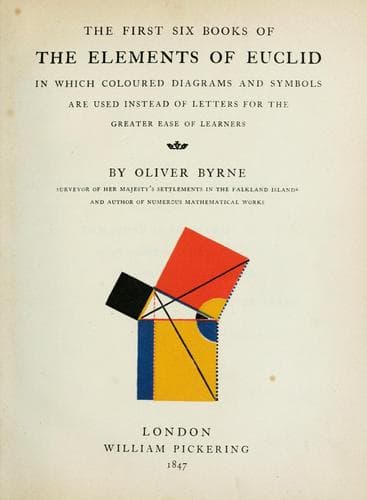
The First Six Books of the Elements of EuclidEuclid
Science
The First Six Books of the Elements of Euclid
Euclid
Euclid's Elements; Mathematics, Greek
Dem.—From the construction it is evident that the figures are equiangular, and
it is only required to prove that the sides about the equal angles are proportional.
Now because the triangle ABH is equiangular to CDE, AB : BH :: CD : DE [iv.];
hence the sides about the equal angles B and D are proportional. Again, from the
same triangles we have BH : HA :: DE : EC, and from the triangles IHA, FEC;
HA : HI :: EC : EF; therefore (ex æquali) BH : HI :: DE : EF; that is, the sides
about the equal angles BHI, DEF are proportional, and so in like manner
are the sides about the other equal angles. Hence (Def. i.) the figures are
similar.
Observation.—In the foregoing construction, the line AB is homologous to CD, and it is evident
that we may take AB to be homologous to any other side of the given figure CDEFG. Again, in
each case, it the figure ABHIJ be turned round the line AB until it falls on the other side, it will
still be similar to the figure CDEFG. Hence on a given line AB there can be constructed two figures
each similar to a given figure CDEFG, and having the given line AB homologous to any given side
CD of the given figure.
The first of the figures thus constructed is said to be directly similar, and the second inversely
similar to the given figure. These technical terms are due to Hamilton: see “Elements of
Quaternions,” page 112.
Cor. 1.—Twice as many polygons may be constructed on AB similar to a given
polygon CDEFG as that figure has sides.
Cor. 2.—If the figure ABHIJ be applied to CDEFG so that the point A will
coincide with C, and that the line AB may be placed along CD, then the points H,
I, J will be respectively on the lines CE, CF, CG; also the sides BH, HI, IJ of the
one polygon will be respectively parallel to their homologous sides DE, EF, FG of
the other.
Cor. 3.—If lines drawn from any point O in the plane of a figure to all its angular
points be divided in the same ratio, the lines joining the points of division will form a
new figure similar to, and having every side parallel to, the homologous side of the
original.
PROP. XIX.—Theorem.
Similar triangles (ABC, DEF) have their areas to one another in the
duplicate ratio of their homologous sides.
Dem.—Take BG a third proportional to BC, EF [xi.]. Join AG. Then because
the triangles ABC, DEF are similar, AB : BC :: DE : EF; hence (alternately)
AB : DE :: BC : EF; but BC : EF :: EF : BG (const.); therefore [V. xi.]
AB : DE :: EF : BG; hence the sides of the triangles ABG, DEF about the equal
angles B, E are reciprocally proportional; therefore the triangles are equal. Again,
since the lines BC, EF, BG are continual proportionals, BC : BG in the duplicate
ratio of BC : EF [V. Def. x.]; but BC : BG :: triangle ABC : ABG. Therefore
ABC : ABG in the duplicate ratio of BC : EF; but it has been proved that the
triangle ABG is equal to DEF. Therefore the triangle ABC is to the triangle DEF
in the duplicate ratio of BC : EF.
Public-domain text, read in full here on John Shaqi.
Reviews
Reviews
No reviews yet
Be the first to share your thoughts on this work.
Elsewhere in the archive
Join the Discussion
Join the discussion
Sign in to leave a comment or review.
Sign InorCreate an account