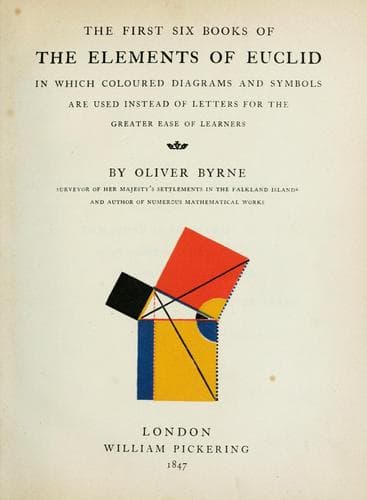
The First Six Books of the Elements of EuclidEuclid
Science
The First Six Books of the Elements of Euclid
Euclid
Euclid's Elements; Mathematics, Greek
This is the first Proposition in Euclid in which the technical term “duplicate
ratio” occurs. My experience with pupils is, that they find it very difficult to
understand either Euclid’s proof or his definition. On this account I submit the
following alternative proof, which, however, makes use of a new definition of the
duplicate ratio of two lines, viz. the ratio of the squares (see Annotations on
V. Def. x.) described on these lines.
On AB and DE describe squares, and through C and F draw lines parallel to AB
and DE, and complete the rectangles AI, DN.
Now, the triangles JAC, ODF are evidently equiangular.
Hence JA : AC :: OD : DF [iv.];
but AC : AB :: DF : DE [iv.].
Hence JA : AB :: OD : DE (ex æquali);
but AB = AG, and DE = DL;
therefore JA : AG :: OD : DL.
Again, JA : AG :: AI : square AH [i.],
and OD : DL :: DN : square DM [i.].
Hence AI : AH :: DN : DM;
therefore AI : DN :: AH : DM [V. xvi.];
hence △ABC : △DEF :: AB2 : DE2.
Exercises.
1. If one of two similar triangles has its sides 50 per cent. longer than the homologous sides of
the other; what is the ratio of their areas?
2. When the inscribed and circumscribed regular polygons of any common number of sides to a
circle have more than four sides, the difference of their areas is less than the square of the side of the
inscribed polygon.
PROP. XX.—Theorem.
Similar polygons may be divided (1) into the same number of similar triangles; (2)
the corresponding triangles have the same ratio to one another which the polygons
have; (3) the polygons are to each other in the duplicate ratio of their homologous
sides.
Dem.—Let ABHIJ, CDEFG be the polygons, and let the sides AB, CD be
homologous. Join AH, AI, CE, CF.
1. The triangles into which the polygons are divided are similar. For, since the
polygons are similar, they are equiangular, and have the sides about their
equal angles proportional [Def. i.]; hence the angle B is equal to D, and
AB : BH :: CD : DE; therefore [vi.] the triangle ABH is equiangular to CDE;
hence the angle BHA is equal to DEC; but BHI is equal to DEF (hyp.);
therefore the angle AHI is equal to CEF. Again, because the polygons are
similar, IH : HB :: FE : ED; and since the triangles ABH, CDE are similar,
HB : HA :: ED : EC; hence (ex aequali) IH : HA :: FE : EC, and the angle IHA
has been proved to be equal to the angle FEC; therefore the triangles IHA, FEC
are equiangular. In the same manner it can be proved that the remaining triangles
are equiangular.
2. Since the triangle ABH is similar to CDE, we have [xix.].
In like manner,
AHI : CEF in the duplicate ratio of AH : CE;
hence
ABH : CDE
= AHI : CEF [V. xi.].
Similarly,
AHI : CEF
= AIJ : CFG.
In these equal ratios, the triangles ABH, AHI, AIJ are the antecedents, and the
Public-domain text, read in full here on John Shaqi.
Reviews
Reviews
No reviews yet
Be the first to share your thoughts on this work.
Elsewhere in the archive
Join the Discussion
Join the discussion
Sign in to leave a comment or review.
Sign InorCreate an account