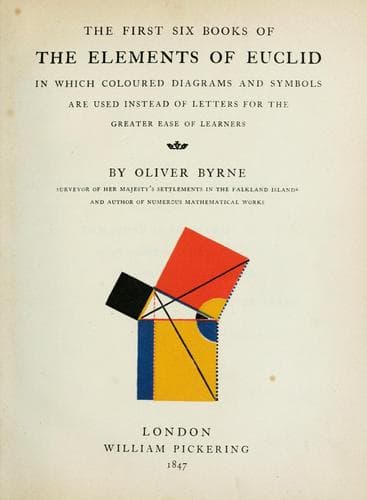
The First Six Books of the Elements of EuclidEuclid
Science
The First Six Books of the Elements of Euclid
Euclid
Euclid's Elements; Mathematics, Greek
triangles CDE, CEF, CFG the consequents, and [V. xii.] any one of these equal
ratios is equal to the ratio of the sum of all the antecedents to the sum of all the
consequents; therefore the triangle ABH : the triangle CDE :: the polygon ABHIJ :
the polygon CDEFG.
3. The triangle ABH : CDE in the duplicate ratio of AB : CD [xix.]. Hence
(2) the polygon ABHIJ : the polygon CDEFG in the duplicate ratio of
AB : CD.
Cor. 1.—The perimeters of similar polygons are to one another in the ratio of
their homologous sides.
Cor. 2.—As squares are similar polygons, therefore the duplicate ratio of two
lines is equal to the ratio of the squares described on them (compare Annotations,
V. Def. x.).
Cor. 3.—Similar portions of similar figures bear the same ratio to each other as
the wholes of the figures.
Cor. 4.—Similar portions of the perimeters of similar figures are to each other in
the ratio of the whole perimeters.
Exercises.
Def. i.—Homologous points in the planes of two similar figures are such, that
lines drawn from them to the angular points of the two figures are proportional to
the homologous sides of the two figures.
1. If two figures be similar, to each point in the plane of one there will be a corresponding point
in the plane of the other.
Dem.—Let ABCD, A′B′C′D′ be the two figures, P a point in the plane of ABCD. Join AP,
BP, and construct a triangle A′P′B′ on A′B′, similar to APB; then it is easy to see that lines from
P′ to the angular points of A′B′C′D′ are proportional to the lines from P to the angular points of
ABCD.
2. If two figures be directly similar, and in the same plane, there is in the plane a special point
which, regarded as belonging to either figure, is its own homologous point with respect to the other.
For, let AB, A′B′ be two homologous sides of the figures, C their point of intersection. Through the
two triads of points A, A′, C; B, B′, C describe two circles intersecting again in the point O: O will
be the point required. For it is evident that the triangles OAB, OA′B′ are similar and
that either may be turned round the point O, so that the two bases, AB, A′B′, will be
parallel.
Def. ii.—The point O is called the centre of similitude of the figures. It is also
called their double point.
3. Two regular polygons of n sides each have n centres of similitude.
4. If any number of similar triangles have their corresponding vertices lying on three given lines,
they have a common centre of similitude.
5. If two figures be directly similar, and have a pair of homologous sides parallel, every pair of
homologous sides will be parallel.
Def. iii.—Two figures, such as those in 5, are said to be homothetic.
6. If two figures be homothetic, the lines joining corresponding angular points are concurrent,
and the point of concurrence is the centre of similitude of the figures.
Public-domain text, read in full here on John Shaqi.
Reviews
Reviews
No reviews yet
Be the first to share your thoughts on this work.
Elsewhere in the archive
Join the Discussion
Join the discussion
Sign in to leave a comment or review.
Sign InorCreate an account