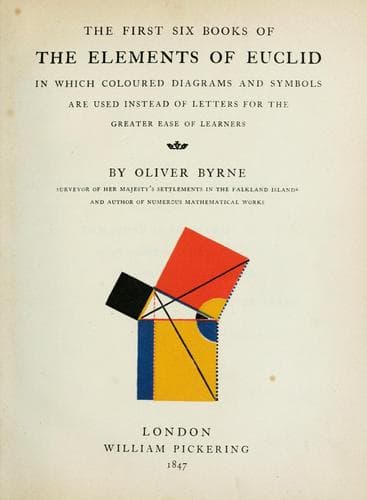
The First Six Books of the Elements of EuclidEuclid
Science
The First Six Books of the Elements of Euclid
Euclid
Euclid's Elements; Mathematics, Greek
7. If two polygons be directly similar, either may be turned round their centre of similitude until
they become homothetic, and this may be done in two different ways.
8. Two circles are similar figures.
Dem.—Let O, O′ be their centres; let the angle AOB be indefinitely small, so that the arc AB
may be regarded as a right line; make the angle A′O′B′ equal to AOB; then the triangles AOB,
A′O′B′ are similar.
Again, make the angle BOC indefinitely small, and make B′O′C′ equal to it; the
triangles BOC, B′O′C′ are similar. Proceeding in this way, we see that the circles can be
divided into the same number of similar elementary triangles. Hence the circles are similar
figures.
9. Sectors of circles having equal central angles are similar figures.
10. As any two points of two circles may be regarded as homologous, two circles have in
consequence an infinite number of centres of similitude; their locus is the circle, whose diameter is
the line joining the two points for which the two circles are homothetic.
11. The areas of circles are to one another as the squares of their diameters. For they are to one
another as the similar elementary triangles into which they are divided, and these are as the squares
of the radii.
12. The circumferences of circles are as their diameters (Cor. 1).
13. The circumference of sectors having equal central angles are proportional to their radii.
Hence if a, a′ denote the arcs of two sectors, which subtend equal angles at the centres, and if r, r′
be their radii, = .
14. The area of a circle is equal to half the rectangle contained by the circumference
and the radius. This is evident by dividing the circle into elementary triangles, as in
Ex. 8.
15. The area of a sector of a circle is equal to half the rectangle contained by the arc of the
sector and the radius of the circle.
PROP. XXI.—Theorem.
Rectilineal figures (A, B), which are similar to the same figure (C), are
similar to one another.
Dem.—Since the figures A and C are similar, they are equiangular, and have the
sides about their equal angles proportional. In like manner B and C are equiangular,
and have the sides about their equal angles proportional. Hence A and B are
equiangular, and have the sides about their equal angles proportional. Therefore they
are similar.
Cor.—Two similar rectilineal figures which are homothetic to a third are
homothetic to one another.
Exercise.
If three similar rectilineal figures be homothetic, two by two, their three centres of similitudes
are collinear.
PROP. XXII—Theorem.
Public-domain text, read in full here on John Shaqi.
Reviews
Reviews
No reviews yet
Be the first to share your thoughts on this work.
Elsewhere in the archive
Join the Discussion
Join the discussion
Sign in to leave a comment or review.
Sign InorCreate an account