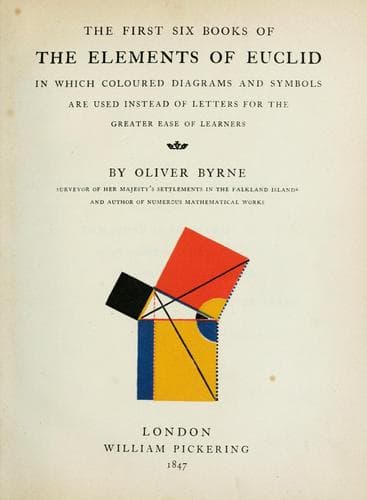
The First Six Books of the Elements of EuclidEuclid
Science
The First Six Books of the Elements of Euclid
Euclid
Euclid's Elements; Mathematics, Greek
If four lines (AB, CD, EF, GH) be proportional, and any pair of similar
rectilineal figures (ABK, CDL) be similarly described on the first and second, and
also any pair (EI, GJ) on the third and fourth, these figures are proportional.
Conversely, if any rectilineal figure described on the first of four right lines: the
similar and similarly described figure described on the second :: any rectilineal figure
on the third : the similar and similarly described figure on the fourth, the four lines
are proportional.
Dem. 1.—ABK : CDL :: AB2 : CD2. [xx.];
and EI : GJ :: EF2 : GH2 [xx.].
But since AB : CD :: EF : GH,
AB2 : CD2 :: EF2 : GH2 [V. xxii., Cor. 1];
therefore ABK : CDL :: EI : GJ.
If ABK : CDL :: EI : GJ, AB : CD :: EF : GH.
3 Dem. 2.—ABK : CDL :: AB2 : CD2 [xx.],
and EI : GJ :: EF2 : GH2 [xx.];
therefore AB2 : CD2 :: EF2 : GH2.
Hence AB : CD :: EF : GH.
The enunciation of this Proposition is wrongly stated in Simson’s Euclid, and
in those that copy it. As given in those works, the four figures should be
similar.
PROP. XXIII.—Theorem.
Equiangular parallelograms (AD, CG) are to each other as the rectangles
contained by their sides about a pair of equal angles.
Dem.—Let the two sides AB, BC about the equal angles ABD, CBG,
be placed so as to form one right line; then it is evident, as in Prop. xiv.,
that GB, BD form one right line. Complete the parallelogram BF. Now,
denoting the parallelograms AB, BF, CG by X, Y , Z, respectively, we
have—
X : Y :: AB : BC [i.],
Y : Z :: BD : BG [i.].
Hence XY : Y Z :: AB.BD : BC.BG;
or X : Z :: AB.BD : BC.BG.
Observation.—Since AB.BD : BC.BG is compounded of the two ratios AB : BC and BD : BG
[V. Def. of compound ratio], the enunciation is the same as if we said, “in the ratio compounded of
the ratios of the sides,” which is Euclid’s; but it is more easily understood as we have put
it.
Exercises.
1. Triangles which have one angle of one equal or supplemental to one angle of the other, are to
one another in the ratio of the rectangles of the sides about those angles.
2. Two quadrilaterals whose diagonals intersect at equal angles are to one another in the ratio of
the rectangles of the diagonals.
PROP. XXIV.—Theorem.
In any parallelogram (AC), every two parallelograms (AF, FC) which are
about a diagonal are similar to the whole and to one another.
Dem.—Since the parallelograms AC, AF have a common angle, they are
equiangular [I. xxxiv.], and all that is required to be proved is, that the sides about
the equal angles are proportional. Now, since the lines EF, BC are parallel, the
triangles AEF, ABC are equiangular; therefore [iv.] AE : EF :: AB : BC, and the
other sides of the parallelograms are equal to AE, EF; AB, BC: hence the
sides about the equal angles are proportional; therefore the parallelograms
AF, AC are similar. In the same manner the parallelograms AF, FC are
similar.
Public-domain text, read in full here on John Shaqi.
Reviews
Reviews
No reviews yet
Be the first to share your thoughts on this work.
Elsewhere in the archive
Join the Discussion
Join the discussion
Sign in to leave a comment or review.
Sign InorCreate an account