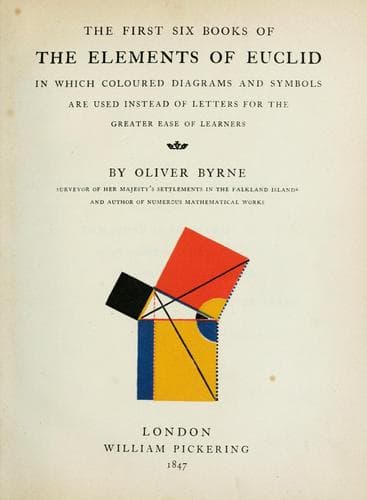
The First Six Books of the Elements of EuclidEuclid
Science
The First Six Books of the Elements of Euclid
Euclid
Euclid's Elements; Mathematics, Greek
Cor.—The parallelograms AF, FC, AC are, two by two, homothetic.
PROP. XXV.—Problem.
To describe a rectilineal figure equal to a given one (A), and similar to another
given one (BCD).
Sol.—On any side BC of the figure BCD describe the rectangle BE equal to
BCD [I. xlv.], and on CE describe the rectangle EF equal to A. Between BC, CF
find a mean proportional GH, and on it describe the figure GHI similar to BCD
[xviii.], so that BC and GH may be homologous sides. GHI is the figure
required.
Dem.—The three lines BC, GH, CF are in continued proportion; therefore
BC : CF in the duplicate ratio of BC : GH [V. Def. x.]; and since the figures BCD,
GHI are similar, BCD : GHI in the duplicate ratio of BC : GH [xx.]; also
BC : CF :: rectangle BE : rectangle EF. Hence rectangle BE : EF :: figure
BCD : GHI; but the rectangle BE is equal to the figure BCD; therefore the
rectangle EF is equal to the figure GHI; but EF is equal to A (const.). Therefore
the figure GHI is equal to A, and it is similar to BCD. Hence it is the figure
required.
Or thus: Describe the squares EFJK, LMNO equal to the figures BCD and A respectively
[II. xiv.]; then find GH a fourth proportional to EF, LM, and BC [xii.]. On GH describe the
rectilineal figure GHI similar to the figure BCD [xviii.], so that BC and GH may be homologous
sides. GHI is the figure required.
Dem.—Because EF : LM :: BC : GH (const.), the figure EFJK : LMNO :: BCD : GHI
[xxii.]; but EFJK is equal to BCD (const.); therefore LMNO is equal to GHI; but LMNO is
equal to A (const.). Therefore GHI is equal to A, and it is similar to BCD.
PROP. XXVI.—Theorem.
If two similar and similarly situated parallelograms (AEFG, ABCD) have a
common angle, they are about the same diagonal.
Dem.—Draw the diagonals (see fig., Prop. xxiv.) AF, AC. Then because the
parallelograms AEFG, ABCD are similar figures, they can be divided into the same
number of similar triangles [xx.]. Hence the triangle FAG is similar to CAD, and
therefore the angle FAG is equal to the angle CAD. Hence the line AC must pass
through the point F, and therefore the parallelograms are about the same
diagonal.
Observation.—Proposition xxvi., being the converse of xxiv., has evidently been misplaced. The
following would be a simpler enunciation:—“If two homothetic parallelograms have a common angle,
they are about the same diagonal.”
PROP. XXVII—Problem.
To inscribe in a given triangle (ABC) the maximum parallelogram having a
common angle (B) with the triangle.
Sol.—Bisect the side AC opposite to the angle B, at P : through P draw
PE, PF parallel to the other sides of the triangle. BP is the parallelogram
required.
Dem.—Take any other point D in AC : draw DG, DH parallel to the sides, and
CK parallel to AB; produce EP, GD to meet CK in K and J, and produce HD to
meet PK in I.
Public-domain text, read in full here on John Shaqi.
Reviews
Reviews
No reviews yet
Be the first to share your thoughts on this work.
Elsewhere in the archive
Join the Discussion
Join the discussion
Sign in to leave a comment or review.
Sign InorCreate an account