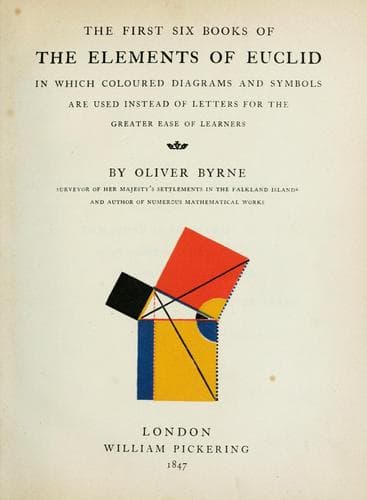
The First Six Books of the Elements of EuclidEuclid
Science
The First Six Books of the Elements of Euclid
Euclid
Euclid's Elements; Mathematics, Greek
Now, since AC is bisected in P, EK is also bisected in P; hence [I. xxxvi.] the
parallelogram EO is equal to OK; therefore EO is greater than DK; but DK is
equal to FD [I. xliii.]; hence EO is greater than FD. To each add BO, and we have
the parallelogram BP greater than BD. Hence BP is the maximum parallelogram
which can be inscribed in the given triangle.
Cor. 1.—The maximum parallelogram exceeds any other parallelogram about the
same angle in the triangle, by the area of the similar parallelogram whose diagonal is
the line between the middle point P of the opposite side and the point D, which is
the corner of the other inscribed parallelogram.
Cor. 2.—The parallelograms inscribed in a triangle, and having one
angle common with it, are proportional to the rectangles contained by the
segments of the sides of the triangle, made by the opposite corners of the
parallelograms.
Cor. 3.—The parallelogram AC : GH :: AC2 : AD.DC.
PROP. XXVIII.—Problem.
To inscribe in a given triangle (ABC) a parallelogram equal to a given rectilineal
figure (X) not greater than the maximum inscribed parallelogram, and having an
angle (B) common with the triangle.
Sol.—Bisect the side AC opposite to B, at P. Draw PF, PE parallel to the
sides AB, BC; then [xxvii.] BP is the maximum parallelogram that can
be inscribed in the triangle ABC; and if X be equal to it, the problem is
solved. If not, produce EP, and draw CJ parallel to PF; then describe the
parallelogram KLMN [xxv.] equal to the difference between the figure
PJCF and X, and similar to PJCF, and so that the sides PJ and KL
will be homologous; then cut off PI equal to KL; draw IH parallel to AB,
cutting AC in D, and draw DG parallel to BC. BD is the parallelogram
required.
Dem.—Since the parallelograms PC, PD are about the same diagonal, they are
similar [xxiv.]; but PC is similar to KPT (const.); therefore PD is similar to KN,
and (const.) their homologous sides, PI and KL, are equal; hence [xx.] PD is equal
to KN. Now, PD is the difference between EF and GH [xxvii. Cor. 1], and KN is
(const.) the difference between PC and X; therefore the difference between PC and
X is equal to the difference between EF and GH; but EF is equal to PC. Hence
GH is equal to X.
PROP. XXIX.—Problem.
To escribe to a given triangle (ABC) a parallelogram equal to a given rectilineal
figure (X), and having an angle common with an external angle (B) of the
triangle.
Sol.—The construction is the same as the last, except that, instead of making
the parallelogram KN equal to the excess of the parallelogram PC over
the rectilineal figure X, we make it equal to their sum; and then make PI
equal to KL; draw IH parallel to AB, and the rest of the construction as
before.
Public-domain text, read in full here on John Shaqi.
Reviews
Reviews
No reviews yet
Be the first to share your thoughts on this work.
Elsewhere in the archive
Join the Discussion
Join the discussion
Sign in to leave a comment or review.
Sign InorCreate an account