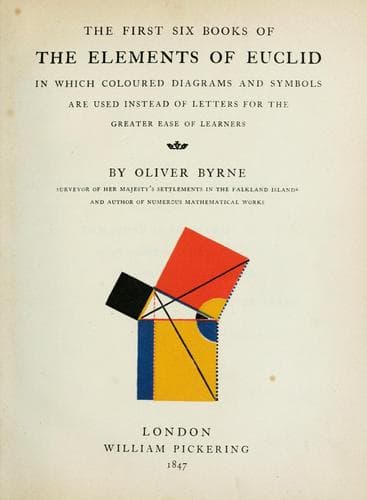
The First Six Books of the Elements of EuclidEuclid
Science
The First Six Books of the Elements of Euclid
Euclid
Euclid's Elements; Mathematics, Greek
Dem.—Now it can be proved, as in II. vi., that the parallelogram BD
is equal to the gnomon OHJ; that is, equal to the difference between the
parallelograms PD and PC, or the difference (const.) between KN and PC; that
is (const.), equal to X, and BD is escribed to the triangle ABC, and has
an angle common with the external angle B. Hence the thing required is
done.
Observation.—The enunciations of the three foregoing Propositions have been altered, in order to
express them in modern technical language. Some writers recommend the student to omit
them—we think differently. In the form we have given them they are freed from their usual
repulsive appearance. The constructions and demonstrations are Euclid’s, but slightly
modified.
PROP. XXX.—Theorem.
To divide a given line (AB) in “extreme and mean ratio.”
Sol.—Divide AB in C, so that the rectangle AB.BC may be equal to the square
on AC [II. xi.] Then C is the point required.
Dem.—Because the rectangle AB.BC is equal to the square on
AC,AB : AC :: AC : BC [xvii.]. Hence AB is cut in extreme and mean ratio in C
[Def. ii.].
Exercises.
1. If the three sides of a right-angled triangle be in continued proportion, the hypotenuse is
divided in extreme and mean ratio by the perpendicular from the right angle on the
hypotenuse.
2. In the same case the greater segment of the hypotenuse is equal to the least side of the
triangle.
3. The square on the diameter of the circle described about the triangle formed by the points F,
H, D (see fig. II. xi.), is equal to six times the square on the line FD.
PROP. XXXI.—Theorem.
If any similar rectilineal figure be similarly described on the three sides of a
right-angled triangle (ABC), the figure on the hypotenuse is equal to the sum of those
described on the two other sides.
Dem.—Draw the perpendicular CD [I. xii.]. Then because ABC is a
right-angled triangle, and CD is drawn from the right angle perpendicular to the
hypotenuse; BD : AD in the duplicate ratio of BA : AC [viii. Cor. 4]. Again,
because the figures described on BA, AC are similar, they are in the duplicate ratio
of BA : AC [xx.]. Hence [V. xi.] BA : AD :: figure described on BA : figure
described on AC. In like manner, AB : BD :: figure described on AB : figure
described on BC. Hence [V. xxiv.] AB : sum of AD and BD :: figure described on
the line AB : sum of the figures described on the lines AC, BC; but AB is equal to
the sum of AD and BD. Therefore [V. a.] the figure described on the line
AB is equal to the sum of the similar figures described on the lines AC and
BC.
Or thus: Let us denote the sides by a, b, c, and the figures by α, β, γ; then
because the figures are similar, we have [xx.]
α : γ
:: a2 : c2
therefore
= .
In like manner,
= ;
therefore
= ;
but a2 + b2 = c2 [I. xlvii.]. Therefore α + β = γ; that is, the sum of the figures on the
sides is equal to the figure on the hypotenuse.
Exercise.
Public-domain text, read in full here on John Shaqi.
Reviews
Reviews
No reviews yet
Be the first to share your thoughts on this work.
Elsewhere in the archive
Join the Discussion
Join the discussion
Sign in to leave a comment or review.
Sign InorCreate an account