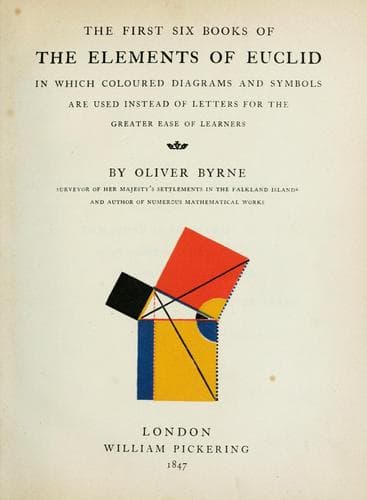
The First Six Books of the Elements of EuclidEuclid
Science
The First Six Books of the Elements of Euclid
Euclid
Euclid's Elements; Mathematics, Greek
Mr. Abbott, f.t.c.d., has informed me that this demonstration was first given by Playfair in
1826, so that Hamilton was anticipated. It has been objected to on the ground that, applied
verbatim to a spherical triangle, it would lead to the conclusion that the sum of the angles is two
right angles, which being wrong, proves that the method is not valid. A slight consideration will
show that the cases are different. In the proof given in the text there are three motions of rotation,
in each of which a point describes an arc of a circle, followed by a motion of translation, in which the
same point describes a right line, and returns to its original position. On the surface of a sphere we
should have, corresponding to these, three motions of rotation, in each of which the point
would describe an arc of a circle, followed by a motion of rotation about the centre of the
sphere, in which the point should describe an arc of a great circle to return to its original
position. Hence, the proof for a plane triangle cannot be applied to a spherical triangle.
________________
NOTE C.
to inscribe a regular polygon of seventeen sides in a circle.
Analysis.—Let A be one of the angular points, AO the diameter, A1, A2, … A8 the vertices at
one side of AO. Produce OA3 to M, and OA2 to P, making A3M = OA5, and A2P = OA8. Again,
cut off A6N = OA7, and A1Q = OA4. Lastly, cut off OR = ON, and OS = OQ. Then we have
[IV. Ex. 40],
ρ1ρ4 = R(ρ3 + ρ5)
= R.OM,
ρ2ρ8 = R(ρ6 − ρ7)
= R.ON;
but
ρ1ρ2ρ4ρ8 =
R4
[IV. Ex. 34];
therefore
OM.ON =
R2
(1).
In like manner,
OP.OQ =
R2
(2).
Again, OM.ON = (ρ3 + ρ5)(ρ6 − ρ7)
= ρ3ρ6 + ρ5ρ6 − ρ3ρ7 − ρ5ρ7
= R(ρ3 − ρ8) + R(ρ1 − ρ6) − R(ρ2 − ρ7) − R(ρ2 − ρ5) [IV. Ex. 40].
= R(OM − ON − OP + OQ) = R(MR − PS) :
MR − PS = R.
Again, MR.PS = (OM − ON)(OP − OQ)
= (ρ3 + ρ5 − ρ6 + ρ7)(ρ2 + ρ8 − ρ1 + ρ4);
and performing the multiplication and substituting, we get
Hence, the rectangle and the difference of the lines MR and PS being given, each is given; hence
MR is given; but MR = OM − ON; therefore OM − ON is given; and we have proved that the
rectangle OM.ON = R2; therefore OM and ON are each given. In like manner, OP and OQ are
each given.
Again,
Hence, since OQ and ON are each given, ρ6 and ρ7 are each given; therefore we can draw these
chords, and we have the arc A6A7 between their extremities given; that is, the seventeenth part of
the circumference of a circle. Hence the problem is solved.
The foregoing analysis is due to Ampere: see Catalan, Théorèmes et Problèmes de Géométrie
Elémentaire. We have abridged and simplified Ampere’s solution.
________________
NOTE D.
to find two mean proportionals between two given lines.
Public-domain text, read in full here on John Shaqi.
Reviews
Reviews
No reviews yet
Be the first to share your thoughts on this work.
Elsewhere in the archive
Join the Discussion
Join the discussion
Sign in to leave a comment or review.
Sign InorCreate an account