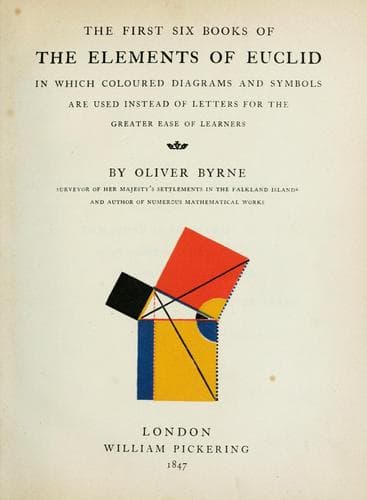
The First Six Books of the Elements of EuclidEuclid
Science
The First Six Books of the Elements of Euclid
Euclid
Euclid's Elements; Mathematics, Greek
The problem to find two mean proportionals is one of the most celebrated in Geometry on
account of the importance which the ancients attached to it. It cannot be solved by the line and
circle, but is very easy by Conic Sections. The following is a mechanical construction by the Ruler
and Compass.
Sol.—Let the extremes AB, BC be placed at right angles to each other; complete the rectangle
ABCD, and describe a circle about it. Produce DA, DC, and let a graduated ruler be made to
revolve round the point B, and so adjusted that BE shall be equal to GF; then AF, CE are two
mean proportionals between AB, BC.
Dem.—Since BE is equal to GF, the rectangle BE.GE = BF.GF. Therefore
DE.CE = DF.AF; hence DE : DF :: AF : CE; and by similar triangles, AB : AF :: DE : DF, and
CE : CB :: DE : DF. Hence AB : AF :: AF : CE; and AF : CE :: CE : CB. Therefore AB, AF,
CE, CB are continual proportions. Hence [VI. Def. iv.] AF, CE are two mean proportionals
between AB and BC.
The foregoing elegant construction is due to the ancient Geometer Philo of Byzantium. If we
join DG it will be perpendicular to EF. The line EF is called Philo’s Line; it possesses the
remarkable property of being the minimum line through the point B between the fixed lines DE,
DF.
Newton’s Construction.—Let AB and L be the two given lines of which AB is the greater.
Bisect AB in C. With A as centre and AC as radius, describe a circle, and in it place the chord CD
equal to the second line L. Join BD, and draw by trial through A a line meeting BD, CD produced
in the points E, F, so that the intercept EF will be equal to the radius of the circle. DE and FA
are the mean proportionals required.
Dem.—Join AD. Since the line BF cuts the sides of the △ ACE, we have
AB.CD.EF = CB.DE.FA; but EF = CB;
therefore AB.CD = DE.FA, or = .
Again, since the △ ACD is isosceles, we have
ED.EC = EA2 − AC2 = (FA + AC)2 − AC2
= 2FA.AC + FA2 = FA.AB + FA2.
Hence ED(ED + CD) = FA(AB + FA),
or DE2 = FA.AB,
therefore DE2 = FA.AB, and we have AB.CD = DE.FA.
Hence AB, DE, FA, CD are in continued
proportion.
________________
NOTE E.
on philo’s line.
I am indebted to Professor Galbraith for the following proof of the minimum property of Philo’s
Line. It is due to the late Professor Mac Cullagh:—Let AC, CB be two given lines, E a fixed point,
CD a perpendicular on AB; it is required to prove, if AE is equal to DB, that AB is a
minimum.
Public-domain text, read in full here on John Shaqi.
Reviews
Reviews
No reviews yet
Be the first to share your thoughts on this work.
Elsewhere in the archive
Join the Discussion
Join the discussion
Sign in to leave a comment or review.
Sign InorCreate an account