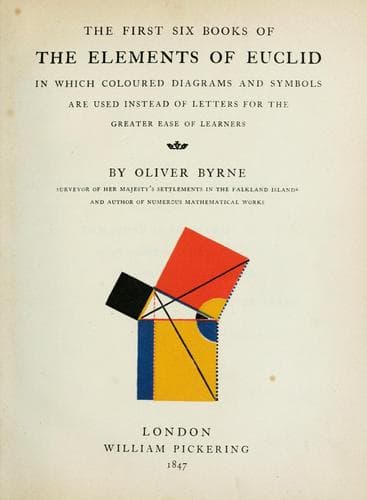
The First Six Books of the Elements of EuclidEuclid
Science
The First Six Books of the Elements of Euclid
Euclid
Euclid's Elements; Mathematics, Greek
Dem.—Through E draw EM parallel to BC; make EN = EM; produce AB until EP = AB.
Through the points N, P draw NT, RP each parallel to AC, and through P draw PQ
parallel to BC. It is easy to see from the figure that the parallelogram QR is equal to the
parallelogram MF, and is therefore given. Through P draw ST perpendicular to EP. Now, since
AE = DB, BP is equal to DB; therefore PS = CD. Again, since OP = AD, PT is equal
to CD; therefore PS = PT. Hence QR is the maximum parallelogram in the triangle
SV T.
Again, if any other line A′B be drawn through E, and produced to P′, so that EP′ = AP′, the
point P′ must fall outside ST, because the parallelogram Q′R′, corresponding to QR, will be equal
to MF, and therefore equal to QR. Hence the line EP′ is greater than EP, or A′B′ is greater than
AB. Hence AB is a minimum.
________________
NOTE F.
on the trisection of an angle.
The following mechanical method of trisecting an angle occurred to me several years ago. Apart
from the interest belonging to the Problem, it is valuable to the student as a geometrical
exercise:—
To trisect a given angle ACB.
Sol.—Erect CD perpendicular to CA; bisect the angle BCD by CG, and make the
angle ECI equal half a right angle; it is evident that CI will fall between CB and CA.
Then, if we use a jointed ruler—that is two equal rulers connected by a pivot—and make
CB equal to the length of one of these rulers, and, with C as centre and CB as radius,
describe the circle BAM, cutting CI in I: at I draw the tangent IG, cutting CG in
G.
Then, since ICG is half a right angle, and CIG is right, IGC is half a right angle; therefore IC
is equal to IG; but IC equal CB; therefore IG = CB—equal length of one of the two equal rulers.
Hence, if the rulers be opened out at right angles, and placed so that the pivot will be at I,
and one extremity at C, the other extremity at G; it is evident that the point B will be
between the two rulers; then, while the extremity at C remains fixed, let the other be
made to traverse the line GF, until the edge of the second ruler passes through B: it is
plain that the pivot moves along the circumference of the circle. Let CH, HF, be the
positions of the rulers when this happens; draw the line CH; the angle ACH is one-third of
ACB.
Dem.—Produce BC to M. Join HM. Erect BO at right angles to BM. Then, because
CH = HF, the angle HCF = HFC, and the angle DCE = ECB (const.). Hence the angle
HCD = HBC [I. xxxii.], and the right angles ACD, CBO are equal; therefore the angle ACH is
equal to HBO; that is [III. xxxii.], equal to HMB, or to half the angle HCB. Hence ACH is
one-third of ACB.
________________
NOTE G.
on the quadrature of the circle.
Public-domain text, read in full here on John Shaqi.
Reviews
Reviews
No reviews yet
Be the first to share your thoughts on this work.
Elsewhere in the archive
Join the Discussion
Join the discussion
Sign in to leave a comment or review.
Sign InorCreate an account