The Five Great Philosophies of LifeHyde, William De Witt
Philosophy
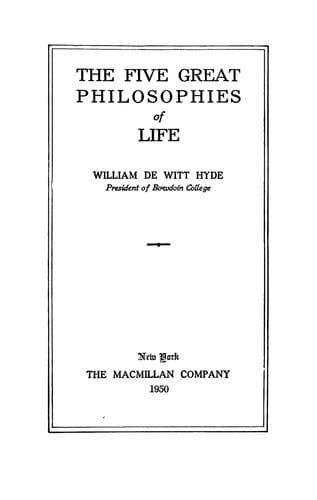
The Five Great Philosophies of Life
Hyde, William De Witt
Ethics; Philosophy, Ancient
Produced by Christina Blust, Juliet Sutherland and the
Online Distributed Proofreading Team at http://www.pgdp.net
THE
FIVE GREAT PHILOSOPHIES
OF LIFE
BY
WILLIAM DE WITT HYDE
PRESIDENT OF BOWDOIN COLLEGE
New York
THE MACMILLAN COMPANY
1924
_All rights reserved_
PRINTED IN THE UNITED STATES OF AMERICA
COPYRIGHT, 1904,
BY THE MACMILLAN COMPANY.
Set up and electrotyped. Published September, 1904. Reprinted
January, 1905; January, 1906; January, 1908; June, 1910.
COPYRIGHT, 1911,
BY THE MACMILLAN COMPANY.
Set up and electrotyped. Published September, 1911. Reprinted
May, 1912; May, 1913; May, 1914; July, 1915; January, November,
1917; August, 1919; February, October, 1920; June, November,
1921; September, 1922; June, 1923; September, 1924.
Norwood Press
J.S. Cushing Co.--Berwick & Smith Co.
Norwood, Mass., U.S.A.
PREFACE TO THE SECOND EDITION
When asked why some men with moderate talents and meagre technical
equipment succeed, where others with greater ability and better
preparation fail; why some women with plain features and few
accomplishments charm, while others with all the advantages of beauty
and cultivation repel, we are wont to conceal our ignorance behind the
vague term _personality_. Undoubtedly the deeper springs of personality
are below the threshold of consciousness, in hereditary traits and early
training. Still some of the higher elements of personality rise above
this threshold, are reducible to philosophical principles, and amenable
to rational control.
The five centuries from the birth of Socrates to the death of Jesus
produced five such principles: the Epicurean pursuit of pleasure, genial
but ungenerous; the Stoic law of self-control, strenuous but forbidding;
the Platonic plan of subordination, sublime but ascetic; the
Aristotelian sense of proportion, practical but uninspiring; and the
Christian Spirit of Love, broadest and deepest of them all.
The purpose of this book is to let the masters of these sane and
wholesome principles of personality talk to us in their own words; with
just enough of comment and interpretation to bring us to their points of
view, and make us welcome their friendly assistance in the philosophical
guidance of life.
Why a new edition under a new title? Because "From Epicurus to Christ"
had an antiquarian flavor; while the book presents those answers to the
problem of life, which, though offered first by the ancients, are still
so broad, deep, and true that all our modern answers are mere varieties
of these five great types. Because the former title suggested that the
historical aspect was a finality; whereas it is here used merely as the
most effective approach to present-day solutions of the fundamental
problems of life.
Public-domain text, read in full here on John Shaqi.
Reviews
Reviews
No reviews yet
Be the first to share your thoughts on this work.
Join the Discussion
Join the discussion
Sign in to leave a comment or review.
Sign InorCreate an account