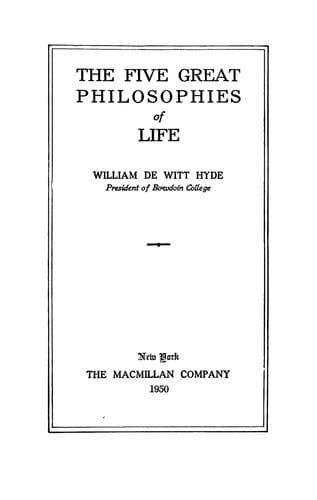
The Five Great Philosophies of LifeHyde, William De Witt
Philosophy
The Five Great Philosophies of Life
Hyde, William De Witt
Ethics; Philosophy, Ancient
"Why rewrite the last chapter?" Because, while the faith of the world
has found in Jesus much more than a philosophy of life, in its quest for
greater things it has almost overlooked that. Yet Jesus' Spirit of Love
is the final philosophy of life.
To the question in its Jewish form, "What is the great commandment?"
Jesus answers, "The first is Love to God; and the second, just like it,
Love to man." Translated into modern, ethical terms his philosophy of
life is a grateful and helpful appreciation; first of the whole system
of relations, physical, mental, social, and spiritual, as Personal like
ourselves, but Infinite, seeking perfection, caring for each lowliest
member as an essential and precious part of the whole; and, second, of
other finite and imperfect persons, whose aims, interests, and
affections are just as real, and therefore to be held just as sacred, as
our own.
To love, to dwell in this grateful and helpful appreciation of the
Father and our brothers,--this is life: and all that falls short of it
is intellectually the illusion of selfishness; spiritually the death
penalty of sin.
From this central point of view every phase of Jesus' teaching, his
democracy, compassion, courage, humility, earnestness, charitableness,
sacrifice, can be shown to flow straight and clear.
Of course such a limitation to his philosophy of life leaves out of
account all supernatural and eschatological considerations. We here
consider only the truth and worth of the teaching; not who the Teacher
is, nor what may happen to us hereafter if we obey or disobey.
Yet even from this limited point of view we may get a glimpse, more real
and convincing than any to be gained by the traditional, dogmatic
approach, of the divine and eternal quality of both Teacher and
teaching--we may see that beyond Love truth cannot go; above Love life
cannot rise; that he who loves is one with God; that out of Love all is
hell, whether here or hereafter; and that in Love lies heaven, both now
and forevermore.
WILLIAM DE WITT HYDE.
BOWDOIN COLLEGE,
BRUNSWICK, MAINE,
July 25, 1911.
CONTENTS
CHAPTER I
THE EPICUREAN PURSUIT OF PLEASURE PAGE
I. Selections from the Epicurean Scriptures 1
II. The Epicurean View of Work and Play 20
III. The Epicurean Price of Happiness 29
IV. The Defects of Epicureanism 36
V. An Example of Epicurean Character 46
VI. The Confessions of an Epicurean Heretic 53
CHAPTER II
STOIC SELF-CONTROL BY LAW
Public-domain text, read in full here on John Shaqi.
Reviews
Reviews
No reviews yet
Be the first to share your thoughts on this work.
Join the Discussion
Join the discussion
Sign in to leave a comment or review.
Sign InorCreate an account