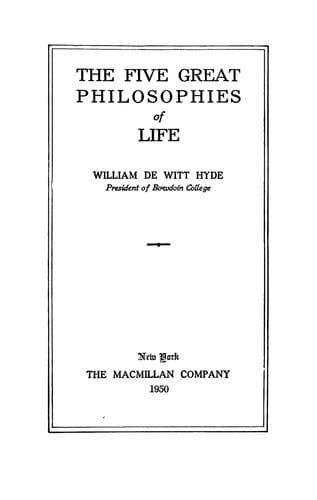
The Five Great Philosophies of LifeHyde, William De Witt
Philosophy
The Five Great Philosophies of Life
Hyde, William De Witt
Ethics; Philosophy, Ancient
He who heartily loves and serves others will trust Love in God and his
fellows to take proper care of himself. One who really loves others will
take reasonable care not to be a burden to them, and to the world, and
will avail himself of the insurance company, the savings bank, and the
bond market as the devices of a complex modern society to distribute
losses and conserve gains to the common advantage of all. Love does not
make the individual or his family a parasite on the economy and industry
of society. Love makes a man bear his own permanent burden as a
preliminary to being of much use and no harm to his family, his friends,
and his community. Such prudent provision of the means of Love's
independence and service is consistent with entire absence of worry
about one's personal fortunes. The essential question which Love, and
Jesus as the Lord and Master of Love, puts to a man is not "How much
money have you?" but "What use do you intend to make of whatever you
have, be that little or much?" If that aim is selfish, and the money is
either saved or spent in sordid, worried selfishness, that low aim makes
the money a curse. If held subject to whatever drafts Love may make upon
it,--whether gifts to the poor, or support of good causes, or employment
of honest workmen, or development of industrial enterprises, be the form
Love's drafts take,--then all wealth so held is a blessing to the world
and an honour to its owner, a glory to God and a service to man.
"Therefore I say unto you, Be not anxious for your life, what ye shall
eat, or what ye shall drink, nor yet for your body, what ye shall put
on. Is not the life more than the food, and the body than the raiment?
Behold the birds of the heaven, that they sow not, neither do they reap,
nor gather into barns; and your heavenly Father feedeth them. Are not ye
of much more value than they? And which of you by being anxious can add
one cubit unto his stature? And why are ye anxious concerning raiment?
Consider the lilies of the field, how they grow; they toil not, neither
do they spin; yet I say unto you, that even Solomon in all his glory was
not arrayed like one of these. But if God doth so clothe the grass of
the field, which to-day is, and to-morrow is cast into the oven, shall
he not much more clothe you, O ye of little faith? Be not therefore
anxious, saying, What shall we eat? or, What shall we drink? or,
Wherewithal shall we be clothed? For after all these things do the
Gentiles seek; for your heavenly Father knoweth that ye have need of all
these things."
Public-domain text, read in full here on John Shaqi.
Reviews
Reviews
No reviews yet
Be the first to share your thoughts on this work.
Elsewhere in the archive
Join the Discussion
Join the discussion
Sign in to leave a comment or review.
Sign InorCreate an account