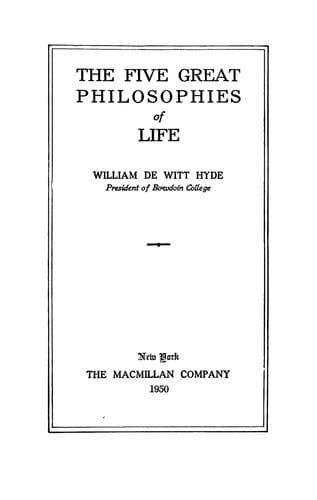
The Five Great Philosophies of LifeHyde, William De Witt
Philosophy
The Five Great Philosophies of Life
Hyde, William De Witt
Ethics; Philosophy, Ancient
"That is not easy, my Lillo. It is only a poor sort of happiness that
could ever come by caring very much about our own narrow pleasures. We
can only have the highest happiness, such as goes along with being a
great man, by having wide thoughts, and much feeling for the rest of the
world as well as ourselves; and this sort of happiness often brings so
much pain with it, that we can only tell it from pain by its being what
we would choose before everything else, because our souls see it is
good. There are so many things wrong and difficult in the world, that no
man can be great--he can hardly keep himself from wickedness--unless he
gives up thinking much about pleasure or rewards, and gets strength to
endure what is hard and painful. My father had the greatness that
belongs to integrity; he chose poverty and obscurity rather than
falsehood. And there was Fra Girolamo--you know why I keep to-morrow
sacred; he had the greatness which belongs to a life spent in struggling
against powerful wrong, and in trying to raise men to the highest deeds
they are capable of. And so, my Lillo, if you mean to act nobly and
seek to know the best things God has put within reach of men, you must
learn to fix your mind on that end, and not on what will happen to you
because of it. And remember, if you were to choose something lower, and
make it the rule of your life to seek your own pleasure, and escape from
what is disagreeable, calamity might come just the same; and it would be
calamity falling on a base mind, which is the one form of sorrow that
has no balm in it, and that may well make a man say, 'It would have been
better for me if I had never been born.'"
The trouble with Epicureanism is its assumption that the self is a
bundle of natural appetites and passions, and that the end of life is
their gratification. Experience shows, as in the case of Tito, that such
a policy consistently pursued, brings not pleasure but pain--pain first
of all to others, and then pain to the individual through their
contempt, indignation, and vengeance. The truest pleasure must come
through the development within one of generous emotions, kind
sympathies, and large social interests. The man must be made over before
the pleasures of the new man can be rightly sought and successfully
found. This making over of man is no consistent part of the logical
Epicurean programme, and consequently pure Epicureanism is sure to land
one in the narrowness, selfishness, and heartlessness of a Tito Melema,
and to bring upon one essentially the same condemnation and disaster.
Public-domain text, read in full here on John Shaqi.
Reviews
Reviews
No reviews yet
Be the first to share your thoughts on this work.
Join the Discussion
Join the discussion
Sign in to leave a comment or review.
Sign InorCreate an account