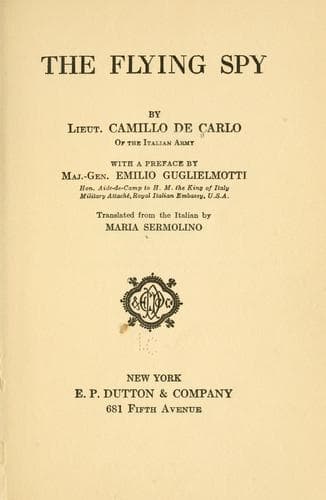
World War, 1914-1918 -- Personal narratives, Italian
The aeroplane is used in the field of tactics and in the field of
strategy. In the former it is especially useful in compiling a series
of uninterrupted photographs in which not a millimeter of the enemy’s
territory escapes the sensitive negative. By studying these photographs
one gathers a notion of the course of the enemy trenches and the
position of their artillery. In the field of strategy the aeroplane
penetrates far into the enemy territory to observe points of especial
importance. After our retreat, for instance, at a certain time, it was
necessary for our command to know whether the enemy had restored the
bridges on the Isonzo, on the Tagliamento and on the Livenza. A patrol
of five chasing machines started out together each entrusted with the
task of observing and photographing a small zone. Several hours later,
our command was informed of all it wanted to know. To frustrate these
observations the enemy had recourse to several agencies.
“Camouflage,” introduced by the enemy to render everything less visible
from on high, is now universally known. But besides this, there are
other tricks used in warfare to fool the enemy. When we were on the
Carso, during one of our offensives, while the enemy was amassing great
forces to oppose our advance up the back of the Faiti, the aviators who
for many days had been flying over the large valley of Brestovizza,
were able to observe from on high long lines of wagons and great
columns of artillery directed from Goyansco towards the Nabresina
valley. From information later received from deserters we learnt that
the wagons were empty, that the cannons were of wood, and that the
enemy had planned all that complicated demonstration show of force as a
fiction to deceive us about its real center of reinforcement. The
Germans were also in the habit of constructing entire fictitious
aviation camps so as to induce Allied aviators to believe that great
offensive preparations were being centered at that point whereas in
reality the enemy planes were gathering quietly elsewhere.
Similar methods have at times been adopted by us to protect our
stations from enemy bombardments. At Udine the various stations were
kept completely dark at night and nearby a fictitious station was
erected which was always kept light, in the hope that some deceived
aviator might waste his bombs upon it.
An important means of observing what happens behind the enemy lines are
the Drago balloons. Their task is not only to direct the fire of our
artillery and to discover, from the flashes, the position of the enemy
guns, but to notice all that which happens within the inner lines of
the enemy. Their observations are in certain cases more efficient than
those from the aeroplanes, since being ever at a constant altitude,
they can follow with greater attention every small particular.
Public-domain text, read in full here on John Shaqi.
Reviews
Reviews
No reviews yet
Be the first to share your thoughts on this work.
Join the Discussion
Join the discussion
Sign in to leave a comment or review.
Sign InorCreate an account