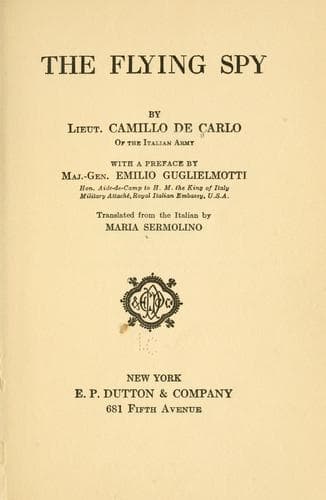
World War, 1914-1918 -- Personal narratives, Italian
Since I was well acquainted with the German language, I was assigned
the special task of questioning the prisoners and of translating such
documents and diaries as were often enough found upon them. The work
was interesting and gave me a clear conception of the terrible and
disastrous condition of our lands after the invasion of the enemy.
While reading or listening to the account of some especially frightful
deed, I often asked myself whether, if those of our soldiers who knew
not how to lay down their lives for their country to keep the enemy
from violating their lands, had known some of the facts I know, they
would not have found strength enough to resist. Ought not the Italian
soldiers, who during the terrible days of October were compelled to
abandon the villages which they had won, for which they had suffered
and fought, know what became of those regions and their people, after
their departure? Had not the inhabitants placed implicit faith in the
ability of the soldiers to resist; looking upon them as protecting
brothers? Yet later, these same soldiers were compelled to abandon to
the enemy, one by one, these very towns and villages, whose terrorized
inhabitants were then compelled to fly, so relinquishing the uttermost
of their possessions to the mercy of the invader.
Among the many documents which passed through my hands were not lacking
some of considerable importance. I see before me a letter, found in the
pocket of a subaltern officer of the Fourth German Army, which he had
not had time to dispatch. In part the letter read:
“Dear Friend:
“After a painful time, the good Lord God gave us wings and, from
the icy and snowy caves, has transported us into a magnificent
country. We were half-dead, but now we are beginning to
resuscitate. This is a splendid country. There is everything one
wants; food and drink enough for all to choke on, rice and coffee
in abundance and enough red wine to bathe in.”
Another letter found on a German prisoner reads:
“We are living like princes, we have food and drink, and may it
always continue thus! If only I could send some to my family in
Berlin. But there is not room for much in our packs, and
furthermore, one would have to carry it for days along mountainous
roads a distance of about thirty-five or forty kilometers. Right
now we have before us a whole cheese, round and large as a cart
wheel, and we don’t know what to do with it. No one is hungry, yet
the cheese is good.”
Such acknowledgments filled me with rage. Those who yesterday were
hungry are now full and they have filled themselves by stealing from
our homes!
The many documents which passed through my hands demonstrated how
extensive were the requisitions of the Germans who robbed the poor
peasants of the things they needed most.
From the notebook of a Czech officer, a deserter, under date of
November 15, 1917, I read:
Public-domain text, read in full here on John Shaqi.
Reviews
Reviews
No reviews yet
Be the first to share your thoughts on this work.
Join the Discussion
Join the discussion
Sign in to leave a comment or review.
Sign InorCreate an account