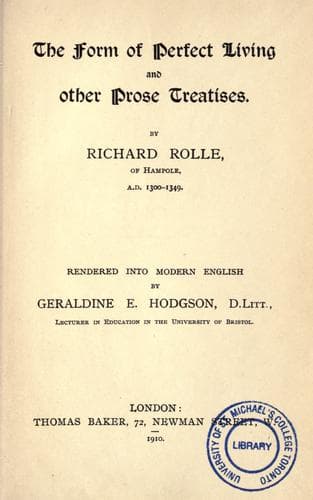
The Form of Perfect Living and Other Prose TreatisesRolle, Richard, of Hampole
Religion
The Form of Perfect Living and Other Prose Treatises
Rolle, Richard, of Hampole
Christian life; Rolle, Richard, of Hampole, 1290?-1349
Introduction xi.
The Form of Perfect Living 1
Our Daily Work (a Mirror of Discipline).
(_From the Arundel MS._) 83
On Grace. (_From the Arundel MS._) 169
An Epistle on Charity 185
Contrition 190
Scraps from the Arundel MS. 192
Introduction.
Richard Rolle of Hampole is the earliest in time of our famous English
Mystics. Born in or about 1300, he died in 1349, seven years after
Mother Julian of Norwich was born. Walter Hilton died in 1392.
An exhaustive account of Rolle's life is given in Vol. ii. of Professor
Horstman's Edition of his works, a book unfortunately out of print. The
main facts are recorded in a brief "Life" appended to Fr. R. Hugh
Benson's _A Book of the Love of_ JESUS. Therefore, it will suffice to
say here that Richard Rolle seems to have been born at Thornton, near
Pickering, in Yorkshire, in or about 1300; that, finding the atmosphere
of Oxford University uncongenial, he left it, and for some four years
was supported, as a hermit, by the Dalton Family. By the end of that
time, through prayer, contemplation and self-denial, he had attained the
three stages of mystical life which he describes as _calor_, _dulcor_,
_canor_; (heat, sweetness, melody.) The next period of his life was less
easy. Having left the protection of the Daltons, and being without those
means of subsistence which are within the reach of priest or monk, this
hermit depended for his daily bread on other men's kindness. Not that he
was a useless person: apart from the utility of a life of Prayer, he
could point to counsel and exhortation given; to the existence of
converts consequent upon his ministrations. To add to his difficulties,
he preached a doctrine of high pure selflessness with which, the average
man, in all times, seems to have no abundant sympathy: and to crown all
he was endowed by nature with a sensitive temper. His remarkable gifts
forced him into public notice; his cast of thought and his temperament
were not calculated to win him ease or popularity. Professor Horstman is
peculiarly severe to those among his enemies and detractors "who called
themselves followers and disciples of Christ." The insertion here of
this painful passage would introduce a jarring note; moreover, the raked
embers of past controversy seldom tend to the spiritual improvement of
the present. An interesting judgment by Professor Horstman on Rolle's
place in mysticism is too long for quotation; but the following sentence
may be taken as the pith of it:--"His position as a mystic was mainly
the result of the development of scholasticism. The exuberant luxuriant
growth of the brain in the system of Scotus called forth the reaction
of the heart, and this reaction is embodied in Richard Rolle, who as
exclusively represents the side of feeling as Scotus that of reason and
Public-domain text, read in full here on John Shaqi.
Reviews
Reviews
No reviews yet
Be the first to share your thoughts on this work.
Join the Discussion
Join the discussion
Sign in to leave a comment or review.
Sign InorCreate an account