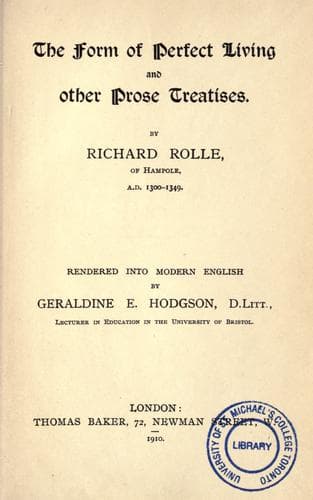
The Form of Perfect Living and Other Prose TreatisesRolle, Richard, of Hampole
Religion
The Form of Perfect Living and Other Prose Treatises
Rolle, Richard, of Hampole
Christian life; Rolle, Richard, of Hampole, 1290?-1349
logical consequence; either lacking the corrective of the other
element."
It is consoling to know that Rolle's last years were passed in peace, in
a cell, near a monastery of Cistercian nuns at Hampole, where the nuns
supported him, while he acted as their spiritual adviser.
In the book mentioned above, Fr. Hugh Benson has translated some of
Richard Rolle's Poems, and certain devotional Meditations. In this
Volume, four of his Prose Treatises have been selected from the rest of
his works, in the belief that they may supplement those parts of Rolle's
writings with which, those who are interested in these phases of
thought, are already familiar.
The first, _The Form of Perfect Living_, is a Rule of Life which he
wrote for a nun of Anderby, Margaret Kirkby, of whom Professor Horstman
writes: "She seems to have been his good angel, and perhaps helped to
smooth down his ruffled spirits. This friendship was lasting--it lasted
to their lives' ends."
This treatise was written of course to meet the requirements of the
"religious" life. It has seemed expedient, because supplementary, then,
to put next to it his work on _Our Daily Life_, which was meant for
those who are "in the world"; and which may give pause to some who might
otherwise criticise the first hastily, perhaps condemning it as
unpractical, or even objectionable in a world where, after all, men must
eat and drink and live, and where some, therefore must provide the
necessary means. Most intensely practical is this second treatise, and
perhaps nowhere more so than when it meets the needs of those who are
inclined to split straws over the definition of the word "good." What
_is_ a good action?--such people love to inquire, and like "jesting
Pilate," sometimes do not "stay for an answer." Richard Rolle has no
manner of doubt about his reply. An action must be good in itself,
_i.e._, so he would tell us, pleasing to God in its own nature. But the
matter by no means ends there for him. This good action must be
performed,--and it is this which is, now palpably, now subtly,
hard--_entirely_ for the sake of goodness, without the slightest taint
of self-seeking, of vanity, of secret satisfaction that we are not as
other men are, not even as this Pharisee or this Publican.
Such a motive, inspiring each person's whole work, would surely go far
to remove what is known as the Social Problem. It would make many a
house the dwelling of peace, many a business-place an abode of honour.
If we could get back to Richard Rolle's simplicity and to his unmovable
faith, then, his goal, even the acquisition of perfect love, might seem
to all of us less distressingly remote.
The present rendering has been taken from the longer and more elaborate
of the two MSS. containing the Treatise. The shorter form of his work
_On Grace_ and _the Epistle_ have been added in the hope that they may
meet the need of all, contemplative or active as they may chance to be.
Public-domain text, read in full here on John Shaqi.
Reviews
Reviews
No reviews yet
Be the first to share your thoughts on this work.
Join the Discussion
Join the discussion
Sign in to leave a comment or review.
Sign InorCreate an account