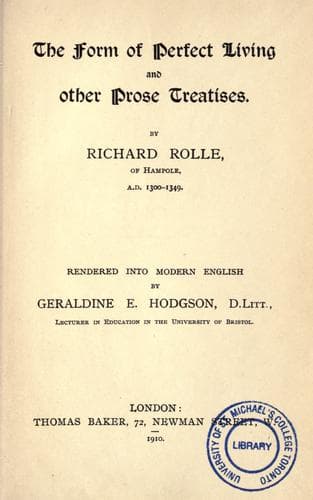
The Form of Perfect Living and Other Prose Treatises — John Shaqi
The Form of Perfect Living and Other Prose TreatisesRolle, Richard, of Hampole
Religion
The Form of Perfect Living and Other Prose Treatises
Rolle, Richard, of Hampole
Christian life; Rolle, Richard, of Hampole, 1290?-1349
Surely no one need fear that the outcome of a study of Richard Rolle
will be effeminacy. Not that that indeed is the special temptation of
the English: a chill commonplace acquiescence in a convenient, if
baseless, hope that somehow "things will come all right," is far more
likely to lead them astray than any "burning yearning to GOD with a
wonderful delight and certainty." Is not George Herbert's cry apposite
still?
"O England, full of sin, but most of sloth!"
Nor can any one argue fairly that this absorption of the mystic is just
selfish idleness. It is, so it seems, as we read Rolle's injunctions, of
the nature of hard exacting toil. No doubt, there must be those who do
the material work of the world; who gain, among other things, those
"goods" which go to support the Mystics. But there will be no lack of
such workers, through the inroads of religion; the broad ways of daily
life are in no danger of contracting suddenly in to the path to the
strait gate. Moreover, natural life itself is a poor thing unsupported
by an unseen stream of spiritual refection. Here, as elsewhere in the
ordered economy of things, two forms of life are found to be
complementary. It is true, as Dr. Bigg once wrote:--"If Society is to be
permeated by religion, there must be reservoirs of religion like those
great storage places up among the hills which feed the pipes by which
water is carried to every home in the city. We shall need a special
class of students of GOD, men and women whose primary and absorbing
interest it is to work out the spiritual life in all its purity and
integrity."[2] It is indeed the idlest of criticism that condemns such
people as slothful or selfish.
There is one charm in our own Mystics which we may miss in S. John of
the Cross or S. Teresa for example; viz., that with all their zeal,
there is also an amazing reality and simplicity down at the bottom of
it, which may seem to us not present in the rhapsodies of more southern
lovers; though in all probability such seeming is purely racial.
Nevertheless, we may be thankful if we find the antidote to our national
prosaic ways in the sane zeal of others of our nation.
Lastly, as men read, they may be overcome perhaps by despair. This pure
untainted selflessness of which Richard Rolle writes almost glibly, how
can it be possible here and now? How can men and women, fixed in and
condemned to the dusty ways of common life, unable as they are to leave
the world even if they would, how can they so much as dream of such
unattainable heights? Is there no help for them in the often quoted
lines of a later English Mystic?--
"Who aimeth at the sky
Shoots higher much than he who means a tree."
For plain men and women, the key to the problem may lie in the question
put by Robert Browning into the mouth of Innocent XII.:--
Public-domain text, read in full here on John Shaqi.
Reviews
Reviews
No reviews yet
Be the first to share your thoughts on this work.
Join the Discussion
Join the discussion
Sign in to leave a comment or review.
Sign InorCreate an account