The Form of Perfect Living and Other Prose Treatises — John Shaqi
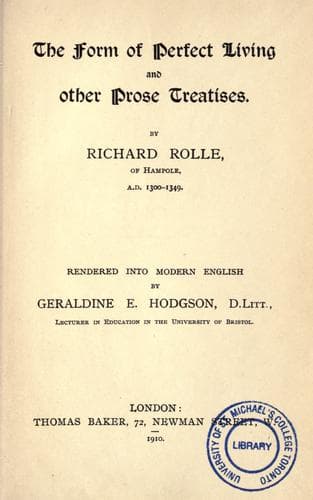
The Form of Perfect Living and Other Prose TreatisesRolle, Richard, of Hampole
Religion
The Form of Perfect Living and Other Prose Treatises
Rolle, Richard, of Hampole
Christian life; Rolle, Richard, of Hampole, 1290?-1349
Above all things, Rolle aims at a perfect balance, culminating in a
harmony ruled by one power, and that the greatest in the world, Love.
Real love, he asks; not the degraded things to which men give that great
name, as to every passing gust of feeling, to every unworthy untamed
emotion: but the divine quality, when to the "lastingness," which he
requires, is also joined that which is the inner essence of Love, viz.,
sacrifice. "Love is a life," he writes, "joining together the loving and
the loved." And then he remembers the other great gift to men,
intellectual sincerity, which has inspired all "who follow Truth along
her star-paved way"; and he gives to that its place and due: "Truth may
be without love: but it cannot help without it." Even then, the whole
tale is not complete; the way of the Saints is not "Primrosed and hung
with shade." Love, with Rolle, is no easy sentimentality: it involves
definite sacrifice in more directions than one; it demands thought,
perseverance, supernatural strength, natural strenuousness; it is not a
selfish enjoyment of a circumambient atmosphere wrapping humanity,
without responsibility or effort of its own: "Love is a _Life_."
"Love," he writes, "is a perfection of learning; virtue of prophecy;
fruit of truth; help of sacraments; establishing of wit and knowledge;
riches of pure men: life of dying men. So, how good love is. If we
suffer to be slain; if we give all that we have (down) to a beggar's
staff: if we know as much as men may know on earth, all this is naught
but ordained sorrow and torment." Then, with that sound sense, which is
not the least element in the sum of his attractiveness, he utters a
subtle warning against that all too common sin, judging one another: "If
thou wilt ask how good is he or she, ask how much he or she loves: and
that no man can tell. For I hold it folly to judge a man's heart, that
none knows save GOD."
After this it cannot be necessary to say that Rolle is a true mystic.
"Many," so he tells us in this same chapter x., "Many speak and do good,
and love not GOD." But that will not suffice his exacting demands. A man
is not "good" until his interior disposition be all filled and taken up
with pure love of GOD. And as he analyses the Christian Character, there
is a pleasant blunt directness about this holy man:--"he that says he
loves GOD and will not do what is in him to shew love, tell him that he
lies."
It is possible that the alarming list of sins of the heart, in chapter
vi., may give the heedless and even the heedful matter for grave
thought, as each one finds himself ejaculating with spontaneous
fear--"Who can tell how oft he offendeth? Cleanse thou me from my secret
faults."
Public-domain text, read in full here on John Shaqi.
Reviews
Reviews
No reviews yet
Be the first to share your thoughts on this work.
Join the Discussion
Join the discussion
Sign in to leave a comment or review.
Sign InorCreate an account