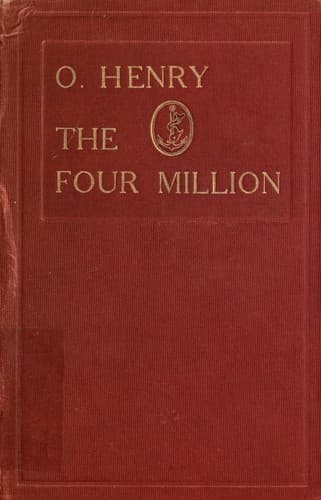
New York (N.Y.) -- Social life and customs -- Fiction; Short stories, American
And also in a moment his heart responded thrillingly to this novel
mood. An instantaneous and strong impulse moved him to battle with his
desperate fate. He would pull himself out of the mire; he would make a
man of himself again; he would conquer the evil that had taken
possession of him. There was time; he was comparatively young yet; he
would resurrect his old eager ambitions and pursue them without
faltering. Those solemn but sweet organ notes had set up a revolution
in him. To-morrow he would go into the roaring downtown district and
find work. A fur importer had once offered him a place as driver. He
would find him to-morrow and ask for the position. He would be somebody
in the world. He would—
Soapy felt a hand laid on his arm. He looked quickly around into the
broad face of a policeman.
“What are you doin’ here?” asked the officer.
“Nothin’,” said Soapy.
“Then come along,” said the policeman.
“Three months on the Island,” said the Magistrate in the Police Court
the next morning.
AN ADJUSTMENT OF NATURE
In an art exhibition the other day I saw a painting that had been sold
for $5,000. The painter was a young scrub out of the West named Kraft,
who had a favourite food and a pet theory. His pabulum was an
unquenchable belief in the Unerring Artistic Adjustment of Nature. His
theory was fixed around corned-beef hash with poached egg. There was a
story behind the picture, so I went home and let it drip out of a
fountain-pen. The idea of Kraft—but that is not the beginning of the
story.
Three years ago Kraft, Bill Judkins (a poet), and I took our meals at
Cypher’s, on Eighth Avenue. I say “took.” When we had money, Cypher got
it “off of” us, as he expressed it. We had no credit; we went in,
called for food and ate it. We paid or we did not pay. We had
confidence in Cypher’s sullenness and smouldering ferocity. Deep down
in his sunless soul he was either a prince, a fool or an artist. He sat
at a worm-eaten desk, covered with files of waiters’ checks so old that
I was sure the bottomest one was for clams that Hendrik Hudson had
eaten and paid for. Cypher had the power, in common with Napoleon III.
and the goggle-eyed perch, of throwing a film over his eyes, rendering
opaque the windows of his soul. Once when we left him unpaid, with
egregious excuses, I looked back and saw him shaking with inaudible
laughter behind his film. Now and then we paid up back scores.
Public-domain text, read in full here on John Shaqi.
Reviews
Reviews
No reviews yet
Be the first to share your thoughts on this work.
Join the Discussion
Join the discussion
Sign in to leave a comment or review.
Sign InorCreate an account