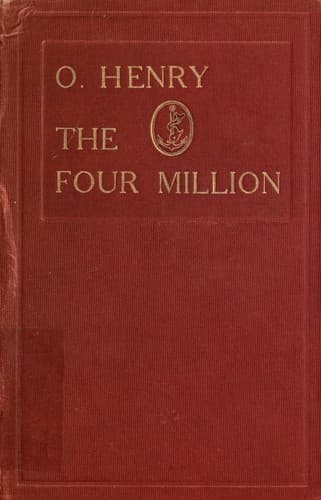
New York (N.Y.) -- Social life and customs -- Fiction; Short stories, American
But the chief thing at Cypher’s was Milly. Milly was a waitress. She
was a grand example of Kraft’s theory of the artistic adjustment of
nature. She belonged, largely, to waiting, as Minerva did to the art of
scrapping, or Venus to the science of serious flirtation. Pedestalled
and in bronze she might have stood with the noblest of her heroic
sisters as “Liver-and-Bacon Enlivening the World.” She belonged to
Cypher’s. You expected to see her colossal figure loom through that
reeking blue cloud of smoke from frying fat just as you expect the
Palisades to appear through a drifting Hudson River fog. There amid the
steam of vegetables and the vapours of acres of “ham and,” the crash of
crockery, the clatter of steel, the screaming of “short orders,” the
cries of the hungering and all the horrid tumult of feeding man,
surrounded by swarms of the buzzing winged beasts bequeathed us by
Pharaoh, Milly steered her magnificent way like some great liner
cleaving among the canoes of howling savages.
Our Goddess of Grub was built on lines so majestic that they could be
followed only with awe. Her sleeves were always rolled above her
elbows. She could have taken us three musketeers in her two hands and
dropped us out of the window. She had seen fewer years than any of us,
but she was of such superb Evehood and simplicity that she mothered us
from the beginning. Cypher’s store of eatables she poured out upon us
with royal indifference to price and quantity, as from a cornucopia
that knew no exhaustion. Her voice rang like a great silver bell; her
smile was many-toothed and frequent; she seemed like a yellow sunrise
on mountain tops. I never saw her but I thought of the Yosemite. And
yet, somehow, I could never think of her as existing outside of
Cypher’s. There nature had placed her, and she had taken root and grown
mightily. She seemed happy, and took her few poor dollars on Saturday
nights with the flushed pleasure of a child that receives an unexpected
donation.
It was Kraft who first voiced the fear that each of us must have held
latently. It came up apropos, of course, of certain questions of art at
which we were hammering. One of us compared the harmony existing
between a Haydn symphony and pistache ice cream to the exquisite
congruity between Milly and Cypher’s.
“There is a certain fate hanging over Milly,” said Kraft, “and if it
overtakes her she is lost to Cypher’s and to us.”
“She will grow fat?” asked Judkins, fearsomely.
“She will go to night school and become refined?” I ventured anxiously.
“It is this,” said Kraft, punctuating in a puddle of spilled coffee
with a stiff forefinger. “Caesar had his Brutus—the cotton has its
bollworm, the chorus girl has her Pittsburger, the summer boarder has
his poison ivy, the hero has his Carnegie medal, art has its Morgan,
the rose has its—”
“Speak,” I interrupted, much perturbed. “You do not think that Milly
will begin to lace?”
Public-domain text, read in full here on John Shaqi.
Reviews
Reviews
No reviews yet
Be the first to share your thoughts on this work.
Join the Discussion
Join the discussion
Sign in to leave a comment or review.
Sign InorCreate an account