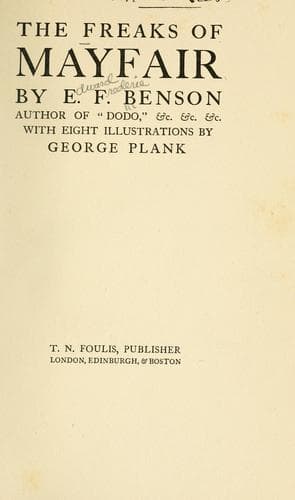
The Freaks of MayfairBenson, E. F. (Edward Frederic)
General
The Freaks of Mayfair
Benson, E. F. (Edward Frederic)
England -- Social life and customs -- 20th century -- Fiction; Humorous stories, English; Short stories, English
The pity of it all is the appalling waste among asps of brains,
inventive faculty, and humour. If only their gifts were used to some
laudable or even only innocent purpose, the world in general would gain
a great deal of entertainment, and the asps of the popularity and
success that they secretly crave for. As it is, some sort of moral
ptomaine has infected them, some invasion of microbes that turns their
wit into poison. Whatsoever things are loathsome, whatsoever things are
of ill report, they think of those things. All their wit, too, goes to
waste: nobody cares two straws what they say, and the bitten are
pathetically unconscious of having received any injury whatever. That
fact, perhaps, if they could thoroughly realise it, might draw their
fangs.
CHAPTER FIVE
THE SEA-GREEN INCORRUPTIBLE
Constance Lady Whittlemere lives in a huge gloomy house in the very
centre of Mayfair, has a majestic appearance, and is perfectly ready for
the Day of Judgment to come whenever it likes. From the time when she
learned French in the school-room (she talks it with a certain sonorous
air, as if she was preaching a sermon in a cathedral) and played
Diabelli’s celebrated duet in D with the same gifted instructress, she
has always done her duty in every state of life. If she sat down to
think, she could not hit upon any point in which she has not invariably
behaved like a Christian and a lady (particularly a lady). Yet she is
not exactly Pharisaical; she never enumerates even in her own mind her
manifold excellences, simply because they are so much a matter of course
with her. And that is precisely why she is so perfectly hopeless. She
expects it of herself to do her duty, and behave as a lady should
behave, and she never has the smallest misgiving as to her complete
success in living up to this ideal. That being so, she does not give it
another thought, knowing quite well that, whoever else may do doubtful
or disagreeable things, Constance Whittlemere will move undeviatingly on
in her flawless courses, just as the moon, without any diminution of her
light and serenity, looks down on slums or battle-fields, strewn with
the corpses of the morally or physically slain. And Lady Whittlemere,
like the moon, does not even think of saying, ‘Poor things!’ She is much
too lunar.
Public-domain text, read in full here on John Shaqi.
Reviews
Reviews
No reviews yet
Be the first to share your thoughts on this work.
Join the Discussion
Join the discussion
Sign in to leave a comment or review.
Sign InorCreate an account