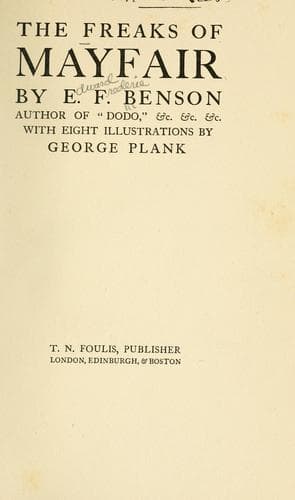
The Freaks of MayfairBenson, E. F. (Edward Frederic)
General
The Freaks of Mayfair
Benson, E. F. (Edward Frederic)
England -- Social life and customs -- 20th century -- Fiction; Humorous stories, English; Short stories, English
At the age of twenty-two (to trace her distressing history) her mother
informed her, at the close of her fourth irreproachable London season,
that she was going to marry Lord Whittlemere. She was very glad to hear
it, for he was completely congenial to her, though, even if she had been
very sorry to hear it, her sense of duty would probably have led her to
do as she was told. But having committed that final act of filial
obedience, she realized that she had a duty to perform to herself in the
person of the new Lady Whittlemere, and climbed up on to a lofty
four-square pedestal of her own. Her duty towards herself was as
imperative as her duty towards Miss Green had been, when she learned the
Diabelli duet in D, and was no doubt derived from the sense of position
that she, as her husband’s wife, enjoyed. Yet perhaps she hardly
‘enjoyed’ it, for it was not in her nature to enjoy anything. She had a
perfectly clear idea, as always, of what her own sense of fitness
entailed on her, and she did it rigidly. ‘The Thing,’ in fact, was her
rule in life. Just as it was The Thing to obey her governess, and obey
her mother, so, when she blossomed out into wifehood, The Thing was to
be a perfect and complete Lady Whittlemere. Success, as always, attended
her conscientious realisation of this. Luckily (or unluckily, since her
hope of salvation was thereby utterly forfeited) she had married a
husband whose general attitude towards life, whose sense of duty and
hidebound instincts, equalled her own, and they lived together, after
that literal solemnization of holy matrimony in St. Peter’s, Eaton
Square, for thirty-four years in unbroken harmony. They both of them had
an unassailable sense of their own dignity, never disagreed on any topic
under the sun, and saw grow up round them a copious family of plain,
solid sons and comely daughters, none of whom caused their parents a
single moment’s salutary anxiety. The three daughters, amply dowried,
got married into stiff mahogany families at an early age, and the sons
continued to prop up the conservative interests of the nation by
becoming severally (i.) a soldier, (ii.) a clergyman, (iii.) a member of
Parliament, (iv.) a diplomatist, and they took into all these liberal
walks of life the traditions and proprieties of genuine Whittlemeres.
They were all Honourables, and all honourable, and all dull, and all
completely conscious of who they were. Nothing could have been nicer.
Public-domain text, read in full here on John Shaqi.
Reviews
Reviews
No reviews yet
Be the first to share your thoughts on this work.
Join the Discussion
Join the discussion
Sign in to leave a comment or review.
Sign InorCreate an account