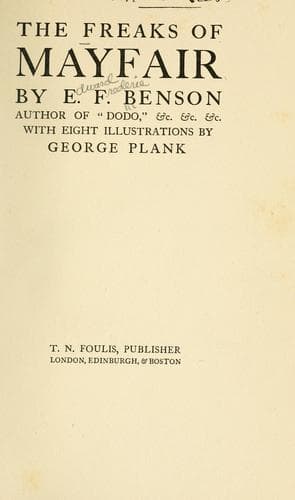
The Freaks of MayfairBenson, E. F. (Edward Frederic)
General
The Freaks of Mayfair
Benson, E. F. (Edward Frederic)
England -- Social life and customs -- 20th century -- Fiction; Humorous stories, English; Short stories, English
At 7.15 P.M. a sonorous gong echoed through the house; Miss Lyall
finished the sentence she was reading, and Lady Whittlemere put her
needle into her work, and said it was time to dress. At dinner, though
both were teetotallers, wine was offered them by the butler, and they
both refused it, and course after course was presented to them by the
two footmen in white stockings and Whittlemere livery and cotton gloves.
Port also was put on the table with dessert, this being the bottle which
had been opened at the last dinner-party, and when Lady Whittlemere had
eaten a gingerbread and drunk half a glass of water they went, not into
the morning-room which they had used during the day, but the large
drawing-room upstairs with the Louis Seize furniture and the cut-glass
chandeliers. Every evening it was all ablaze with lights, and the fire
roared up the chimney: the tables were bright with flowers, and rows of
chairs were set against the wall. Majestically Lady Whittlemere marches
into it, followed by Miss Lyall, and there she plays patience till 10.30
while Miss Lyall looks on with sycophantic congratulations at her
success, and murmured sympathy if the cards are unkind. At 10.30
Branksome the butler throws open the door and a footman brings in a tray
of lemonade and biscuits. This refreshment is invariably refused by both
ladies, and at eleven the house is dark.
Now the foregoing catalogue of events accurately describes Lady
Whittlemere’s day, and in it is comprised the sum of the material that
makes up her mental life. But it is all enacted in front of the
background that she is Lady Whittlemere. The sight of the London
streets, with their million comedies and tragedies, arouses in her no
sympathetic or human current: all she knows is that Lady Whittlemere is
driving down Piccadilly. When the almond blossom comes out in Regent’s
Park, and the grass is yellow with the flowering of the spring bulbs,
her heart never dances with the daffodils; all that happens is that Lady
Whittlemere sees that they are there. She subscribes to no charities,
for she is aware that her husband left her this ample jointure for
herself, and she spends such part of it as she does not save on herself,
on her food and her house and her horses and the fifteen people whose
business it is to make her quite comfortable. She has no regrets and no
longings, because she has always lived perfectly correctly, and does not
want anything. She is totally without friends or enemies, and she is
never surprised nor enthusiastic nor vexed. About six times a year, on
the day preceding one of her dinners, Miss Lyall does not read aloud
after tea, but puts the names of her guests on pieces of cardboard, and
makes a map of the table, while the evening she leaves London for
Hastings or Scotland she stops playing patience at ten, in order to get
a good long night before her journey. She does the same on her arrival
in town again so as to get a good long night after her journey. She
Public-domain text, read in full here on John Shaqi.
Reviews
Reviews
No reviews yet
Be the first to share your thoughts on this work.
Join the Discussion
Join the discussion
Sign in to leave a comment or review.
Sign InorCreate an account