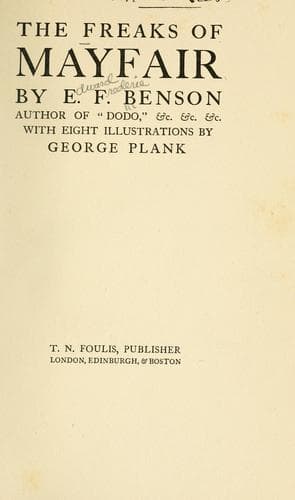
The Freaks of MayfairBenson, E. F. (Edward Frederic)
General
The Freaks of Mayfair
Benson, E. F. (Edward Frederic)
England -- Social life and customs -- 20th century -- Fiction; Humorous stories, English; Short stories, English
It has been mentioned that Sir Louis is in the habit of calling his wife
‘Princess’; it has also been hinted that she alludes to him as ‘Sir
Baronet.’ There is a touch of badinage, of playfulness in both these
titles, but below the playfulness is a substratum of seriousness. For
she is descended from kings so ancient that nobody knows anything about
them, and he is a real Baronet, and since his title in ordinary use is
that of a mere knight, she and others of their intimates are accustomed
to call him Sir Baronet, in order to mark the difference between him and
such people as provincial mayors or eminent actors and musicians. It
must be supposed, too, that he is far from discouraging this, since he
has printed on his cards, ‘Sir Louis Marigold, Bart., M.P.,’ in full. It
may be unusual, but then there are, unfortunately, not many Baronets who
take a proper pride in the honours with which their Sovereign has
decorated them or their ancestors. Marquises and earls put the degree of
their nobility on their cards instead of just calling themselves ‘Lord,’
and surely a Baronet cannot go wrong in following so august an example.
But there is another custom of his to which perhaps exception may be
taken, for it is his habit when entertaining a luncheon-party at which
mere commoners are present (this is not a frequent occurrence) to step
jauntily along in his proper precedence to the dining-room, leaving the
less exalted persons to follow. He does it in a careless, unconscious
manner, and this manner is by no means put on: he walks in front of
lowlier commoners instinctively: he does not think about it: his legs
just take him. It is perhaps scarcely necessary to add that instinct is
not so strong with him as to go in before any lady, even if she were his
own washerwoman, for the obligations of chivalry outweigh with him even
those of nobility. It has always been so with the true aristocrat, and
it is so with him. Perhaps if a Suffragette were present he might go on
ahead, for he considers that all women who hold any views but his on
that subject have unsexed themselves. In his more indulgent moments he
alludes to them as ‘deluded wretches.’
Public-domain text, read in full here on John Shaqi.
Reviews
Reviews
No reviews yet
Be the first to share your thoughts on this work.
Join the Discussion
Join the discussion
Sign in to leave a comment or review.
Sign InorCreate an account