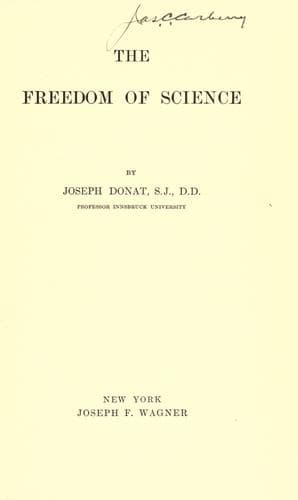
Free thought; Modernism (Christian theology) -- Catholic Church; Religion and science; Teaching, Freedom of
We shall therefore have to distinguish between freedom of research and
freedom of teaching. The neglect of this distinction causes not a little
confusion; thus, if one complains of his convictions being trammeled or
his liberty of conscience being violated, when he is hindered from
immediately proclaiming whatever he calls his convictions. Private
opinion, and the public propaganda of this opinion, are evidently very
different things. It may be that an opinion seems to me the right one,
but, in spite of that, public dissemination of it may, always or under
certain circumstances, mean danger to my fellow-men. If I am for this
reason prevented from publishing it, I am not thereby hindered from giving
it my own private assent. It is, moreover, quite clear that the state—we
disregard here religious authority—cannot at all directly restrict
research, which is something personal. It can only impose restrictions on
the communication of one’s ideas by teaching them to others, which is a
social function.
From these few remarks will be followed the impropriety of the
following, or similar, observations: “The fostering of science and
its teaching are not separate functions ... to insinuate a twofold
function of freedom, viz., that of the savant and that of the
teacher, would be to dissolve the unity of the moral personality”
(_W. Kahl_, Bekenntnissgebundenheit und Lehrfreiheit (1897), 22).
It is not at all double-dealing if some one does not publicly
proclaim one’s private knowledge. Is it double-dealing, is it a
violation of “the unity of the moral personality,” if one is, and
must be, silent about official secrets? And if one does not tell,
and is not allowed to tell, official secrets, if one prevents an
anarchist from spreading his revolutionary ideas, is this a
violation of the unity of the moral personality? It is true that
“to deny one’s convictions is a violation of one of the most
indubitable principles of moral conduct” (_K. v. Amira_, Die
Stellung des akademischen Lehrers zur Freiheit in Forschung und
Lehre. Beilage der Muenchener Neuesten Nachrichten. 9. Juli,
1908). But it is logically incorrect to conclude therefrom that
the freedom of teaching should not be restricted. To keep silence
is not denying one’s convictions. Later on, when speaking of
freedom in teaching, we shall return to this thought and deal with
it more thoroughly.
So far there can be no serious diversity of opinion. Freedom from unjust
restraint is demanded, and rightly demanded, for science. The very object
of science requires it. In scientific research man’s power of discernment
should freely develop; his inclination towards truth should exert itself;
and by communication of acquired knowledge mankind should advance in
mental and material culture.
Public-domain text, read in full here on John Shaqi.
Reviews
Reviews
No reviews yet
Be the first to share your thoughts on this work.
Join the Discussion
Join the discussion
Sign in to leave a comment or review.
Sign InorCreate an account