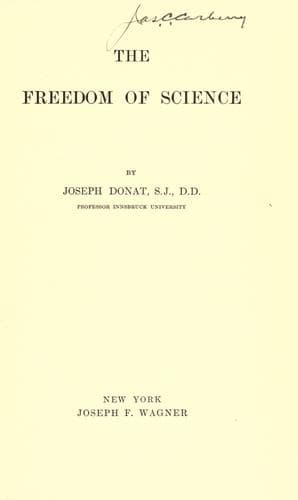
Free thought; Modernism (Christian theology) -- Catholic Church; Religion and science; Teaching, Freedom of
The bud bursts forth and freely unfolds its splendour; the butterfly grows
unhindered in beauty; the tree, too, wants freedom, in order to develop
its boughs and branches according to its nature, and if you try to bind
and tie it, it resists as much as it can. Just so is freedom needful for
the development of the noblest aspirations of human nature, for its
progress in knowledge. Every friend of humanity, every one who loves his
own kind, must be in sympathy with its progress. Who will not rejoice to
see the mind of man happily trace the laws of nature, laid down by the
Spirit of God in the stillness of eternity when as yet there was no
creature to heed, the laws He then placed in nature in order that the
reasonable creature might discern the marks of his Creator? Who would not
rejoice to see man, diligently following the facts of history and studying
the works of literature and art, find therein the ideas of God reflected,
as the rays of the sun in the trembling drop of dew, and, finally, trying
to solve the difficult problems of life? To this end has the Creator
enkindled in the mind of man a spark of His own intelligence; to this end
has He put in him a desire to inquire and learn, a desire which has
exerted itself most in the noblest of men. Man is destined to find his
ultimate gratification in beholding the Eternal Truth and Beauty, a vision
which will be the completion of human science and culture, the highest
perfection of created life. Thus man’s noble desire for knowledge and
truth must develop, it must be able to produce leaves and blossoms. For
this he needs freedom, free air, and free light.
If science is to attain its high purpose, it must have freedom also to
impart the knowledge acquired. It should indeed further the progress of
mankind. By its discovery it should enhance the beauty of human life,
should enrich the treasure of human knowledge, should promote education
and morality, to the honour of the Creator. For this end, too, freedom is
necessary: freedom to impart newly acquired knowledge, else there would be
no pleasure in work, stagnation rather than progress.
Chapter II. Two Views Of The World And Their Freedom.
There can, then, be no difference of opinion on this matter among
sober-minded men: science must be free from all unjust hindrances and
restraint. But we have not yet finished. We have not even proceeded very
far on our way. The further question at once presents itself: Which are
those unjust hindrances and restraints that scientific research and
teaching may reject? May there not perhaps be such which it must respect?
There is little meaning in the cry: Freedom! Freedom! This attractive
word, which always finds an enthusiastic echo in man, may easily prove a
misleading catchword, and become a dangerous weapon of the thoughtless and
the unscrupulous.
Public-domain text, read in full here on John Shaqi.
Reviews
Reviews
No reviews yet
Be the first to share your thoughts on this work.
Join the Discussion
Join the discussion
Sign in to leave a comment or review.
Sign InorCreate an account