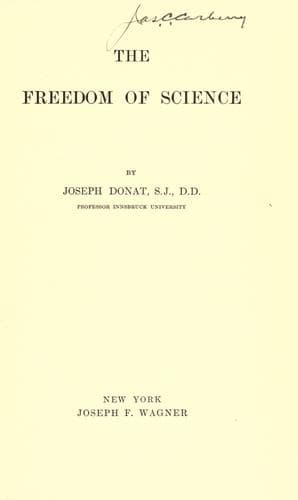
Free thought; Modernism (Christian theology) -- Catholic Church; Religion and science; Teaching, Freedom of
_Plate_ assures us: “I do not know anything about metaphysics.” We
do not want to dispute that. It is regrettable that so many
scientists of our times are betraying a pitiable lack of
philosophical training, a lack which becomes a social danger if
they, nevertheless, yield to the temptation to invade the domain
of Philosophy. Even the Protestant scientist _G. Wobbermin_ in
referring to the above-mentioned discussion remarked: “_Wasmann’s_
opponents on that evening have betrayed without exception a really
amazing lack of philosophical training.” In glaring contrast with
this ignorance stands their intolerance for any different theory
of the world. Because he thinks as a Christian, _Wasmann_ is
peremptorily expelled from the ranks of natural scientists.
“_Father Wasmann_ is not a true natural scientist, he is not a
true scholar.” With this crushing verdict Prof. _Plate_ concluded
his speech. He repeats this finding on the last page of his book
in conspicuous type: “_Father Wasmann_, S. J., no true natural
scientist, no true scholar.” That his opponent, in answer to
questions that go beyond mere natural science, is giving
philosophical replies, in accord with the doctrine of
Christianity, is explained by “his voluntary or involuntary
submission to the Church,” “natural science bows to Theology.” He
therefore lacks “the freedom of thought and of deduction.”
Sophistical stunts in the service of intolerance! But let us
proceed on our way.
The compulsory dogma of the inadmissibility of a supernatural order of the
world, and of its operation in the visible world, becomes most manifest
when liberal science comes in contact with the miracle. Forsooth, it
shirks this contact. But time and again, now and in the past, it is
confronted by clearly attested facts and it cannot avoid noticing them.
However, it is determined from the outset that miracles are impossible. Of
course, this cannot be proved except by the presumption that there is no
supermundane God. Even the agnostic _Stuart Mill_ admits that if the
existence of God is conceded, an effect produced by His will, which in
every instance owes its origin to its creator, appears no longer as a
purely arbitrary hypothesis, but must be considered a serious possibility
(Essays, 1874). Generally, however, liberal science does not try hard to
demonstrate in a scientific way the impossibility.
Public-domain text, read in full here on John Shaqi.
Reviews
Reviews
No reviews yet
Be the first to share your thoughts on this work.
Elsewhere in the archive
Join the Discussion
Join the discussion
Sign in to leave a comment or review.
Sign InorCreate an account