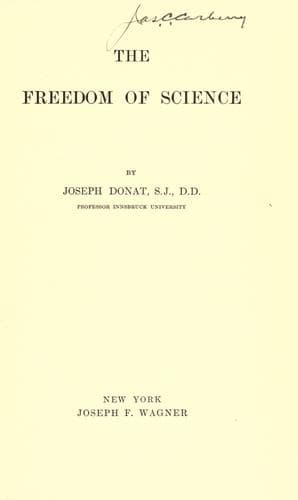
Free thought; Modernism (Christian theology) -- Catholic Church; Religion and science; Teaching, Freedom of
“The world,” _Schopenhauer_ is convinced, “is the projection of my
idea.... No truth is more certain, more independent of all others,
less in need of proof, than this, that all there is to be known,
hence the whole world, is an object only in relation to a subject,
a vision of the beholder; in a word, the projection of my own
idea. Hence the subject is the bearer of the world” (Die Welt als
Wille und Vorstellung, I, §§ 1-2). “It is evidently true that
knowledge cannot go beyond our consciousness, and hence the
existence of things outside of our sphere of consciousness must,
to say the least, remain problematical” (Der Gegenstand der
Erkenntniss, 1892, p. 2). In like manner _O. Liebmann_ says: “We
can never go beyond our individual sphere of ideas (projection of
our ideas), even though we apprehend what is independent of us,
still the absolute reality of it is known to us only as our own
idea” (Zur Analysis der Wirklichkeit, 1900, p. 28). Therefore “the
contrast between ‘I’ and the world,” says _E. Mach_, “between
feeling or apprehension and the reality, falls away” (Die Analysis
der Empfindungen, 2d ed., 1900, p. 9). And a disciple of _Mach_
says: “It is important to hold fast to the idea that a
self-existent, divine Truth, independent of the subject,
objectively binding, enthroned, so to say, above men and gods, is
meaningless.... Such a Truth is nonsense” (_H. Kleinpeter_,
Kantstudien, VIII, 1903, p. 314).
None of these representatives of worldly wisdom are able to fulfil
the first duty of the wise man: “Live according to what you
teach.” Even the sceptic _Hume_ has to admit that in the common
affairs of life he feels himself compelled of necessity to talk
and act like other people.
Subjectivism is really nothing but _scepticism_, for it eliminates the
knowableness of objective truth. But it is a masked—if you will, a
reformed—scepticism. Cognition is given another purpose; its task is not
at all, so it is said, to reproduce or assimilate a world distinct from
itself, but to create its own contents. The very nature of cognition is
reversed.
The Autonomy of Reason.
It was _Kant_, the herald of a new era in philosophy, who gave to this
gradually maturing subjectivism its scientific form and basis. At the same
time he gave prominence to that element of subjectivism which seems to
give justification to freedom of thought, to wit, autonomism, the creative
power of the intellect which makes its own laws. Independence of reason
and free thought have become catchwords since _Kant’s_ time. They are a
precious ingredient of the autonomy of modern man.
Public-domain text, read in full here on John Shaqi.
Reviews
Reviews
No reviews yet
Be the first to share your thoughts on this work.
Join the Discussion
Join the discussion
Sign in to leave a comment or review.
Sign InorCreate an account