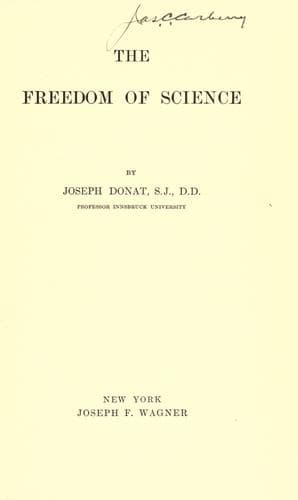
Free thought; Modernism (Christian theology) -- Catholic Church; Religion and science; Teaching, Freedom of
When the flaming blaze of the French Revolution was reddening the skies of
Europe, and inaugurating the restoration of the rights of man, _Kant_ was
sitting in his study at Königsberg, his heart beating strongly in sympathy
with the Revolution, for he saw in it a hopeful turn of the times. An old
man of nearly seventy, he followed the events with most passionate
interest. _Varnhagen_ records in his Memoirs, based on the stories of
_Staegemann_, that, when the proclamation of the Republic was announced in
the newspapers, _Kant_, with tears in his eyes, said to some friends: “Now
can I say with Simeon, ‘Now dost Thou, O Lord, dismiss Thy servant in
peace, because mine eyes have seen Thy Salvation’ ” (_H. Hettner_,
Literaturgeschichte des 18. Jahrh. III, 4th ed., 3, 2, 1894, p. 38). While
on the other side of the Rhine the Jacobins were doing their bloody work
of political liberation, the German philosopher, the herald of a new era
and an ardent admirer of _Rousseau_, sat in his study labouring for man’s
intellectual liberation. To give man the right of autonomous
self-determination in action and thought was the work of his life.
Autonomy was indeed to him “ ‘the source’ of all dignity of man and of
every rational nature” (Grundlegung zur Metaphysik der Sitten, II). And
hence it was that his ardent followers beheld in him “the first perfect
model of a really free German, one who had purged himself from every trace
of Roman absolutism, dogmatism, and anti-individualism” (_H. St.
Chamberlain_, Die Grundlagen des 19. Jahrh., 8th ed., 1907, II, 1127).
Public-domain text, read in full here on John Shaqi.
Reviews
Reviews
No reviews yet
Be the first to share your thoughts on this work.
Join the Discussion
Join the discussion
Sign in to leave a comment or review.
Sign InorCreate an account