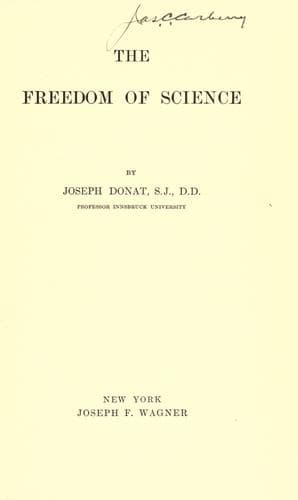
Free thought; Modernism (Christian theology) -- Catholic Church; Religion and science; Teaching, Freedom of
That this relativism is also laying hand, more and more firmly,
upon modern ethics is well known. One often gets the conviction
that, as _E. Westermark_ teaches, “there is no absolute standard
of morality,” that “there are no general truths,” “that all moral
values,” as Prof. _R. Broda_ writes, “are relative and varying
with every people, every civilization, every society, every free
person” (Dokumente des Fortschritts, 1908, 362).
Thus modern subjectivism has lost all sense for definite rules of thought;
in its frantic rush for freedom and in its confused excitement it seeks to
upset all barriers. Now, of course, we may disregard convictions thousands
of years old, by simply observing that they suited former ages but not the
present; that they perhaps suit the uneducated but not the educated.
Henceforth one may also reject the dogmas of _Christianity_ by merely
pointing out that they were at one time of importance, but are not suited
to the modern man. That is an idea readily grasped, one which has already
become quite general with those who are mentally tired of Christianity.
What is demanded is a further evolution also of the Christian religion, a
continuous cultivation of freer, higher forms, an undogmatic Christianity
without duty to believe, without a Church: nothing else, in the end, but a
veiled humanitarian religion.
“It will be difficult for coming generations to understand,” says
_Paulsen_, in the same sense, “how our time could cling in
religious instruction with such peace of mind to a system which,
having originated several centuries ago under entirely different
conditions of intellectual life, stands in striking contrast to
facts and ideas accepted by our time everywhere outside the
schools.” Hence a revision of the fundamental truths of
Christianity is needed. Away with everything supernatural and
miraculous, obedience to faith, original sin, redemption: all this
sounds strange to the modern man. “So there remains but one way:
to adapt the doctrine of the Church to the theories and views of
our times” (System der Ethik, 8th ed., 1906, II, pp. 247, 250).
And _Eucken_ says similarly: “We can adopt the doctrinal system of
the Church only by retiring from the present back to the past”
(Zeitschr. fuer Philosophie u. Phil. Kritik 112, 1898, 165).
Therefore we demand evolution of the Christian religion! “Let us
not blindly follow antiquated doctrines disposed of by science,”
we are exhorted. “Let there be no fear lest our belief in God and
true piety suffer by it! Let us remember that everything earthly
is in continual motion, carried along by the rushing river of
life.” Onward, therefore, to advancement! ... cheerfully avowing
the watchword: “evolution of religion” (_Fr. Delitzsch_, Zweiter
Vortrag ueber Babel u. Bibel, 45. thousand, 1904, 42).
Public-domain text, read in full here on John Shaqi.
Reviews
Reviews
No reviews yet
Be the first to share your thoughts on this work.
Join the Discussion
Join the discussion
Sign in to leave a comment or review.
Sign InorCreate an account