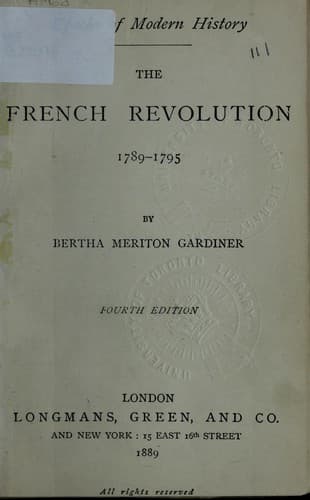
The French Revolution 1789-1795Gardiner, Bertha Meriton
History
The French Revolution 1789-1795
Gardiner, Bertha Meriton
France -- History -- Revolution, 1789-1799
All authorities were equally interested in preserving France from
invasion, and all concurred in making exertions to put soldiers in the
field, and to provide them with the necessary arms and supplies. The
Convention had at once to find forces to besiege the still revolted
towns of Lyons and Toulon, to suppress the rebellious Vendeans in
the east, to fight the Spaniards in the Pyrenees, the Piedmontese
in the Alps, the English and Austrians in the Netherlands, and the
Austrians and the Prussians on the Rhine. None of the usual motives
which cause men to shrink from adopting extraordinary measures were
felt by the existing rulers of France. To recruit the armies, they
resorted to a conscription. All citizens between the ages of eighteen
and twenty-five were called on to serve in person. Urged on by the
Commune, the Convention further decreed a levy of the whole male
population capable of bearing arms (August 23). Such a measure was of
course impracticable, but it enabled the deputies in mission to bring
together large bodies of men to act against Lyons and Toulon, and to
hold in check the insurgent Vendeans.
♦Maximum laws.♦
Between July and October laws were passed fixing prices and carrying
out the economical system long since demanded in the streets. A small
minority, however, alone of those who were willing to adopt them,
regarded them as economically good. Their framers had in reality
ulterior objects in view. The Hébertists desired to ruin the upper
commercial classes. The Montagnards, as a body, hoped to avert a State
bankruptcy by maintaining the value of the assignats in spite of new
issues, and to provide for the armies by putting at the disposition of
the Government the entire resources of the country--its revenue, its
capital, its stock, and its labour. In the spring a decree had been
passed fixing a maximum price for corn, but variable in the different
departments (p. 152). A maximum price for corn and meal was now fixed
without variation for the whole republic. Neither article might be
sold except at fairs and markets, and the trade in both was put under
the supervision of the municipal bodies. Nearly all articles of
consumption, many manufactured articles, and most raw materials, were
also subjected to a maximum price, which was fixed in each department
at the price that the article sold at in 1790, with the addition of a
third as much again (September 17). In order to prevent wholesale or
retail dealers from keeping back goods from sale, they were required
to expose over their shop doors a list of all articles that they had
in stock, and even private individuals were prohibited from laying in
stores. The practice of supplying the army through contractors was
entirely abandoned. Corn, cloth, butter, flour, meat, fodder, cattle,
carts, horses, vessels, and, in a word, all raw materials, manufactured
articles, or live stock immediately or remotely connected with the
Public-domain text, read in full here on John Shaqi.
Reviews
Reviews
No reviews yet
Be the first to share your thoughts on this work.
Elsewhere in the archive
Join the Discussion
Join the discussion
Sign in to leave a comment or review.
Sign InorCreate an account