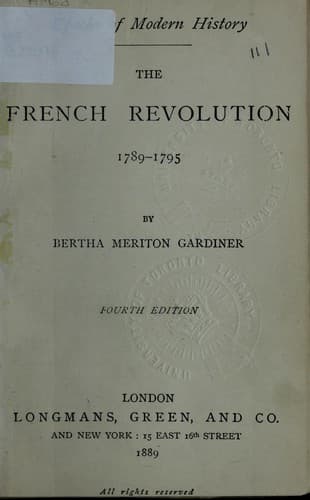
The French Revolution 1789-1795Gardiner, Bertha Meriton
History
The French Revolution 1789-1795
Gardiner, Bertha Meriton
France -- History -- Revolution, 1789-1799
troops of the line and the new recruits, and the operation was actually
carried into effect during the following winter. Thus, in place of the
old royal army there had come into existence a wholly new army, the
creation of the revolution. The troops lacked training and discipline,
but were ready to fight continually against superior numbers, had
confidence in their officers, and were not easily shaken by reverses.
Many officers were unable to read and write, but against this defect
was to be set the advantage that military talent rapidly found its way
to the front. Two-thirds of the regimental officers were elected by
those whom they were to command, one-third was advanced by time of
service. The appointment of the generals the Government reserved to
itself.
[Illustration: THE RHINE
E. Weller.
]
♦Campaign in Belgium.♦
After the surrender of Condé and Valenciennes, the forces of the allies
in Flanders separated. The Duke of York, against Coburg’s desire, went
west to lay siege to Dunkirk, while Coburg himself invested Le Quesnoi.
The Duke’s forces were in two divisions. He himself with 20,000 men
besieged Dunkirk; 15,000 Hanoverians under Freitag remained a few miles
inland to watch the enemy. The commander of the garrison opened the
dykes and flooded the country, cutting off communication between the
two divisions, and confining the Duke’s retreat eastwards to Furnes,
along the sea coast. The French General Houchard, bringing together
50,000 men, overpowered Freitag’s 15,000 at the village of Hondschoote,
and drove them back on Furnes (September 8). The Duke of York, hastily
raising the siege, effected by a night march his retreat to Furnes, and
afterwards rejoined the Austrians. Houchard, accused of treason and
of neglecting to follow up his victory, was guillotined. In his place
was appointed General Jourdan, who in 1791 had entered the army as a
volunteer. Le Quesnoi surrendered to Coburg, and the allies next laid
siege to Maubeuge. Jourdan, bringing together a large force, defeated
at Wattignies 18,000 Austrians, stationed south of the river to guard
against his advance (October 16). Coburg in consequence raised the
siege, and the armies on both sides retired into winter quarters. The
allies during the campaign had won three French fortresses--Condé,
Valenciennes, and Le Quesnoi.
♦Campaign on the Rhine.♦
Public-domain text, read in full here on John Shaqi.
Reviews
Reviews
No reviews yet
Be the first to share your thoughts on this work.
Elsewhere in the archive
Join the Discussion
Join the discussion
Sign in to leave a comment or review.
Sign InorCreate an account