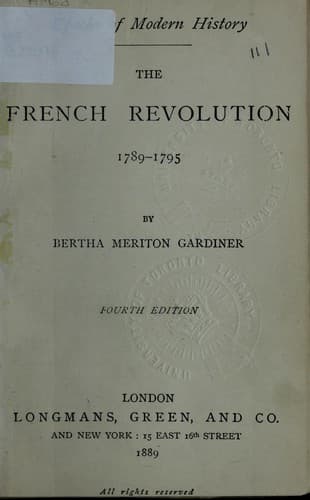
The French Revolution 1789-1795Gardiner, Bertha Meriton
History
The French Revolution 1789-1795
Gardiner, Bertha Meriton
France -- History -- Revolution, 1789-1799
The victory of Wattignies, and still more the expulsion of the allies
from Alsace, affected the relations of the factions which were
struggling for ascendancy in Paris. The Montagnards resented the
subserviency in which they were held by the Commune and by the two
Committees; and as the danger of invasion decreased, the stronger grew
their desire to shake off the oppressive yoke which they had laid
upon themselves by the expulsion of the Girondists. Only a very few
of their number really entertained the same ideas as the Hébertists;
whilst outside the Committees of Public Safety and General Security,
there was scarcely a deputy who did not resent the tyranny exercised by
these Committees. Yet the Montagnards could not regain independence.
They could not appeal to the deputies of the centre, who crouched in
subservience even greater than their own before the Committees and the
Commune. They were themselves without courage or union. All sense of
political honour was dead, and in order to avoid giving offence, where
to do so was dangerous, men were prepared to retract their own words,
and to sacrifice their fellows without compunction. Some Montagnards,
instigated by fear for their own lives, obtained the adoption of a
decree to the effect that the Convention would suffer its members to
speak in self-defence when charges were made against them (November
10). A few days afterwards, on the demand of the Committee of Public
Safety, the Convention repealed this decree, and ordered the arrest of
four deputies, including its proposers against whom a general charge of
conspiring against the Republic was laid by the Committee.
♦The work of the Convention.♦
Happily, this tale of crouching submission to tyranny does not fill
the whole of the annals of the Convention. Men ordinarily silent in
the Convention sought shelter in private committees appointed for the
preparation of special laws. In these, Montagnards and deputies of the
centre still worked side by side, elaborating legislative projects for
the advance of education, the reform of the civil law, the improvement
of agriculture, the draining of marshes, the suppression of mendicity
and the relief of the poor, and others of similar character. Although
much of their labour produced no results, still a considerable
amount of most important legislation was effected, which dated its
commencement from the times when the Girondists had been in power, and
which was far more truly characteristic of the Convention as a body
than the bloody laws which it passed at the dictation of the Committee
of Public Safety speaking in the name of the Jacobins and of the
Commune.
Public-domain text, read in full here on John Shaqi.
Reviews
Reviews
No reviews yet
Be the first to share your thoughts on this work.
Elsewhere in the archive
Join the Discussion
Join the discussion
Sign in to leave a comment or review.
Sign InorCreate an account