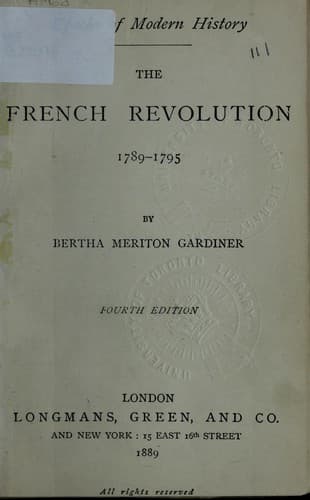
The French Revolution 1789-1795Gardiner, Bertha Meriton
History
The French Revolution 1789-1795
Gardiner, Bertha Meriton
France -- History -- Revolution, 1789-1799
centre, and a temporiser between the Mountain and the Gironde, was
indifferent whether Robespierre or Hébert succumbed, so long as he
found himself on the winning side. Billaud and Collot, who acted
together, were the two most sanguinary men on the committee. They
were connected with the Hébertists. They had no quarrel with the
establishment of the Worship of Reason, and dreaded, by the destruction
of Hébert, to give Robespierre an opportunity of domineering over
themselves. As members of the committee, however, they disliked
the rivalry of the Commune, and they were besides afraid both of
Robespierre’s enmity and of the triumph of the Dantonists. Accordingly,
they were prepared to sacrifice Hébert, so long as they could secure
themselves against reaction by putting Danton to death as well. On
his side, Robespierre was prepared to sacrifice Danton. He could not
join the Dantonist reaction against the Terror without imperilling
his influence at the Jacobins, and forcing Collot and Billaud to make
common cause with Hébert. Moreover, were the Hébertists suppressed
by the triumph of the Dantonists, Robespierre would have to face
the contingency of the Mountain shaking off the control of the two
committees.
♦Robespierre and the Jacobins.♦
The Jacobin club was the field where the battle between Robespierre and
Hébert was first fought out. In this society, which was Robespierre’s
stronghold, Hébert was powerless to contend against him. Many of the
frequenters of the club were indeed Hébertists, but their influence
was small compared with that of Robespierre and his supporters. All
the small tradesmen and artisans who, uninfluenced by sordid motives,
still took interest in political affairs, idolised Robespierre. While
Hébert had the adherence of the unprincipled and vicious only, who were
sure to abandon him in time of peril, Robespierre had the affection of
partisans ready to stand by him, and in case of need to die for him.
His undoubted integrity, his constant talk of virtue and morality, the
reserve of his manner, the very dryness of his language, made a deep
impression upon sincere but narrow and fervent minds. The rough men
and women who frequented the galleries of the Jacobins listened to him
with rapt attention, and applauded his words with such hearty energy
that persons who ventured amongst them without imitating their conduct
became objects of remark. The society which Robespierre thus dominated
was a real political power, and had for long been the instrument by
aid of which he had been able to assume precedence of his colleagues
in the Committee of Public Safety. Every resolution the club adopted
the Convention had ultimately to adopt; and every individual whom the
club proscribed, were he a minister, a general, a deputy, or any other,
went in the course of a few days to prison and the guillotine. No man
was regarded as a good patriot who was not a Jacobin, and hundreds of
persons who never entered the place had, for the sake of security,
Public-domain text, read in full here on John Shaqi.
Reviews
Reviews
No reviews yet
Be the first to share your thoughts on this work.
Elsewhere in the archive
Join the Discussion
Join the discussion
Sign in to leave a comment or review.
Sign InorCreate an account