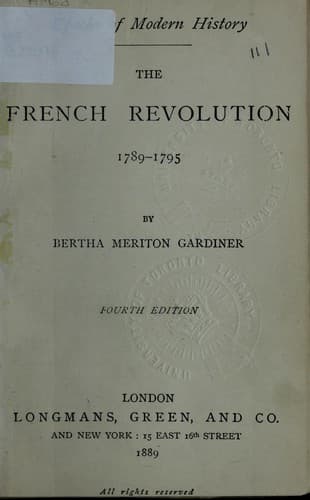
The French Revolution 1789-1795Gardiner, Bertha Meriton
History
The French Revolution 1789-1795
Gardiner, Bertha Meriton
France -- History -- Revolution, 1789-1799
After the nobles had lost political power they were cut off from
all healthy communication with their fellow subjects. In France all
sons and daughters of noblemen were noble, and their families did
not blend with those of other classes like the family of an English
peer. Nobles contemned the service of the administration as beneath
their birth; on the contrary, no one who was not of noble birth could
hold the rank of an officer in the army. The great lords flocked to
Paris and Versailles, where they wasted their substance in extravagant
living; the lesser nobles, men who in England would have occupied the
position of country gentlemen, were often through poverty compelled
to reside in their châteaux, where they lived in isolation, having no
common interests with their neighbours, while clinging tenaciously
to the possession of their rights as proprietors and feudal lords.
♦Feudal rights.♦ These feudal rights varied in every province, but were
of three general kinds. (1) Rights which had their origin when the
seigneur was also ruler--as, for instance, the right of administering
justice, though this he now almost invariably farmed to the highest
bidder; the right of levying tolls at fairs and bridges; and the
exclusive right of fishing and hunting. (2) Peasants in the position of
serfs were only to be found in Alsace and Lorraine; but rights still
existed all over the country which betrayed a servile origin. Thus, the
farmer might not grind his corn but at the seigneur’s mill, nor the
vine-grower press his grapes but at the seigneur’s press; and every man
living on the fief must labour for the seigneur without return so many
days in the year. (3) Finally, the courts ruled that wherever land was
held by a peasant from the owner of a fief, there was a presumption
that the owner retained a claim to enforce cultivation and the payment
of annual dues. Land so held was termed a _censive_--resembling an
English copyhold. The granting of land on these terms never stopped
from the close of the Middle Ages down to the Revolution. The dues
retained were often petty. One tenant might pay a small measure of
oats; another a couple of chickens. Yet the payments were often
sufficiently numerous to form the chief maintenance of many of the
nobles. The holders of these _censives_ possessed however, all the
rights of proprietors. They could not be dispossessed so long as they
paid the dues to which they were liable, and they could sell and devise
the land without the consent of the owners of the fief. Properties held
on these terms abounded in all parts of France, and though the extent
of each _censive_ was often no more than a couple of acres, it is
probable that before the Revolution at least a fifth of the soil had by
these means passed into the possession of the peasantry.
Public-domain text, read in full here on John Shaqi.
Reviews
Reviews
No reviews yet
Be the first to share your thoughts on this work.
Join the Discussion
Join the discussion
Sign in to leave a comment or review.
Sign InorCreate an account